
Blog
Cylinder Head Insurance: Why the JDG10014 is Critical for John Deere Injector Sleeve Service
Cylinder Head Insurance for John Deere PowerTech Diesel Service
.png,600)
A seized injector sleeve can turn a routine head service into a five-figure cylinder head replacement in under sixty seconds. The JDG10014 Servicegard tool is the only thing standing between a clean extraction and a scored bore.
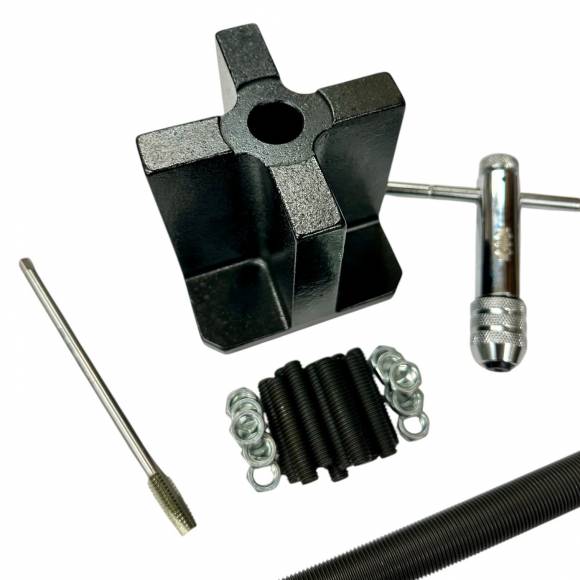
The Real Cost of a Wrong Move on an Injector Sleeve
John Deere electronic injector sleeves are interference-fit into the cylinder head and spend their service life cycling between combustion temperatures and coolant flow. After thousands of hours, galvanic corrosion, carbon build-up, and thermal distortion bond the sleeve to the head like a welded joint. When a tech reaches for a slide hammer, pry bar, or — worst case — a chisel to free one, the sleeve usually wins. The bore gets scored, the sealing surface gets gouged, and the cylinder head gets condemned. One improper pull can eclipse the labor ticket by ten times.
- Controlled Straight-Line Extraction: The JDG10014 applies pulling force along the sleeve's true centerline — no side-loading, no cocking, no bore damage.
- Genuine Servicegard Engineering: Dimensioned specifically for John Deere electronic injector sleeves, so engagement is full-contact and force transfer is predictable.
- Cylinder Head Protection: Preserves bore diameter, sealing shoulders, and o-ring lands — the three surfaces that new sleeves must seat against perfectly.
- Heavy-Duty Build for Repeat Service: Engineered for shop life, not single use — holds dimensional integrity across fleet-scale injector campaigns.
- Eliminates Rework Risk: Stops the comeback cycle of coolant intrusion, fuel dilution, and hot-spot failures caused by poorly seated replacement sleeves.
Why the JDG10014 Pays for Itself on the First Job
A new John Deere cylinder head — depending on the engine family — runs anywhere from $3,500 to upwards of $9,000, and that's before you add the labor to R&R it, re-torque the head, retime the valve train, and re-commission the cooling system. Against that backdrop, the JDG10014 Injector Sleeve Removal Tool at $440 isn't a tool purchase — it's a risk-transfer instrument. It moves the variable of "will this sleeve come out clean?" from hope to engineered certainty. Every shop that services John Deere Tier 3 or Tier 4 diesels should treat this tool as standard inventory, not specialty.
How Injector Sleeves Actually Fail — And Why Removal Gets Hard
Understanding why the JDG10014 is engineered the way it is starts with understanding what's happening inside the head. Injector sleeves (also called injector cups on some engine families) are thin-wall stainless or copper-alloy tubes pressed into the cylinder head bore. The sleeve isolates the injector body from direct coolant contact while allowing heat transfer from the injector nozzle to the cooling jacket. That's the engineering intent.
In the real world, three failure modes drive sleeve replacement. First, combustion gas blow-by past the lower sealing land — often caused by an injector hold-down bolt losing preload — erodes the seat and pushes hot gas into the coolant jacket. Second, coolant leakage past the upper o-ring lets coolant enter the injector bore, corroding the injector body and contaminating fuel. Third, crevice corrosion between the sleeve OD and the head bore ID causes the interference fit to increase over time — the sleeve isn't just stuck, it's chemically bonded.
When a sleeve fails, you cannot reuse it. And when you try to pull a corrosion-bonded sleeve with improvised tooling, the thin wall collapses, the flange shears off, or the bore gets scored by off-axis loading. The JDG10014 engages the sleeve along its full internal geometry and pulls it straight — the only way to get a corroded sleeve out without taking the bore with it.
Real-World Scenario: The Fleet That Learned the Hard Way
Consider a typical construction fleet running a dozen John Deere-powered machines — excavators, wheel loaders, articulated trucks. A coolant-in-oil condition shows up on one unit during routine oil sampling. Root cause: upper injector sleeve o-ring failure. The shop schedules the repair, pulls the valve cover, removes the injectors, and attempts to pull the sleeves using a generic slide-hammer setup.
Two of the six sleeves come out fine. Three require excessive force and come out distorted — still workable, bores are within spec. The sixth sleeve shears at the flange. The tech then attempts to collapse the remaining sleeve wall with a punch to grab it from below. The punch slips, the bore gets gouged, and a $6,200 cylinder head assembly gets added to the repair order. Total cost of the "saved" $440 tool purchase: roughly fourteen times the retail price of the JDG10014 — and that's before downtime losses on a working machine. This exact scenario plays out in shops every week.
Where the JDG10014 Fits in the Service Schedule
Injector sleeve service isn't a scheduled maintenance item the way oil changes or fuel filters are — it's condition-driven. You replace sleeves when you have evidence of failure (coolant loss, fuel in coolant, coolant in the injector bore, combustion gas in the cooling system) or as part of a major in-frame or out-of-frame overhaul. Any time the cylinder head comes off for valve work, head gasket failure, or major rebuild, every sleeve should be pulled, inspected, and replaced as a policy decision — the cost of sleeves is trivial compared to tearing the engine back down later.
This is where the JDG10014 earns its keep on a schedule basis. During any head-off event, a shop equipped with the JDG10014 pulls all sleeves, inspects bores, replaces sleeves with fresh o-rings and seat washers, and closes the engine up knowing the injector sealing system is factory-fresh. Shops without the tool either skip the sleeve service (and risk a comeback) or attempt improvised removal (and risk a cylinder head). Neither is acceptable on a professional-grade repair.
Fleet-Level ROI: Running the Math
Let's make this concrete. Take a medium fleet operation servicing 25 John Deere diesels across construction, ag, or power-generation applications. Industry failure data suggests injector sleeve issues surface on roughly 10–15% of engines over a typical service life — call it three to four sleeve replacement events across that fleet. If one of those events damages a cylinder head due to improper extraction, you're looking at $5,000–$9,000 in parts plus 15–25 hours of additional labor, plus the downtime cost of the machine being out of service.
Against that, the JDG10014 at $440 is a one-time capital expense with a multi-year service life across unlimited sleeve pulls. The breakeven is a single prevented head failure. Every subsequent pull is pure margin preservation. For fleet managers, service managers, and independent shops quoting warranty-sensitive work, this is one of the cleanest ROI cases in the specialty tool catalog.
Factor in the soft costs and the math gets even more favorable. Every hour of unplanned downtime on a production-class John Deere machine — a 9R-series tractor pulling a planter, a 470G excavator on a job site, a standby genset covering a data center — represents direct revenue loss, contract penalty exposure, or operational risk that dwarfs the line-item cost of the repair. Fleet managers already track mean-time-to-repair as a KPI. The JDG10014 compresses MTTR on every injector-sleeve event by eliminating the probability of an extraction going sideways and cascading into a secondary repair. It is one of a small number of specialty tools that have a measurable, repeatable impact on fleet uptime metrics.
There is also a quieter benefit that rarely shows up on spreadsheets: technician confidence. When a tech knows the tool in hand is the correct tool for the job, the work slows down in the right places (inspection, measurement, documentation) and speeds up in the right places (engagement, pulling, reassembly). When a tech is improvising with the wrong tool, the work speeds up where it shouldn't (panic extraction) and slows down where it shouldn't (searching for a workaround after the bore is damaged). Equipping the shop correctly is equipping the technicians correctly — and that shows up in warranty data, comeback rates, and customer retention.
What Sets Servicegard Apart from Generic Tooling
Servicegard is John Deere's factory service tool brand — the same engineering discipline that designs the engines also specifies the tools that service them. That matters more than it sounds. A Servicegard tool is designed against the same drawings, tolerances, and material specifications as the component it services. When John Deere publishes a service procedure that calls for a specific Servicegard part number, they are saying "this tool was engineered against this engine — use it, or accept the risk of a non-spec outcome."
Generic specialty-tool manufacturers work in the opposite direction. They measure a representative sample of OE components, design a tool that engages on the most prominent features, and validate it across whatever sample pool they have access to. That approach works on simple fasteners and non-critical components. It breaks down on precision interference fits like injector sleeves, where dimensional variance of a few thousandths changes whether the tool engages correctly or cocks off-axis under load. The JDG10014 is built to the John Deere drawing — not to a measurement of the John Deere drawing.
When Apex Tool Company sources and supplies the JDG10014, the chain of specification runs from John Deere engineering through the Servicegard program to the shop bench. That is what you are paying for when you select the OE tool over a generic alternative: a documented engineering lineage that protects both the repair and the liability case if anything ever goes wrong.
Planning Ahead: When to Order the JDG10014
The worst time to discover you don't have the right sleeve removal tool is halfway through an injector job with the fuel rail off and the valve cover on the bench. Shops that service John Deere diesels on any recurring basis should have the JDG10014 in the drawer before the first job calls for it — not after. Specialty tools of this kind rarely ship next-day from third-party distributors; if Apex Tool Company has stock at the time of order and the shipping origin aligns, same-day or next-business-day shipment is typical on the JDG10014, but assuming that on every order is how shops get caught short on urgent jobs.
Treat the JDG10014 the way you treat a torque wrench or a compression tester — foundational shop equipment that enables a class of work, not a specialty purchase you make per job. Once it's in the drawer, every John Deere injector-related repair that comes through the bay becomes a predictable, profitable service ticket instead of a coin-flip on the cylinder head.
The Hidden Failure Pattern: Coolant-Side Symptoms
Injector sleeves fail from both sides — the combustion side and the coolant side — and the shop that only watches for one will miss half the diagnostic signal. Combustion-side failure typically announces itself loudly: misfire codes, fuel dilution in the oil sample, visible carbon tracking on the injector body. Coolant-side failure is quieter and arguably more dangerous, because by the time it's obvious, the engine has often already sustained secondary damage. Coolant seeping past a failing upper o-ring runs down into the injector bore, corrodes the injector electrical connections, contaminates fuel lines, and — in worst cases — enters the combustion chamber as a small but persistent leak that accelerates head deposit formation.
The JDG10014 comes into this picture when the diagnostic work confirms sleeve involvement. Once you know you need to pull sleeves, the conversation shifts from "can we fix this cheaper?" to "how do we make sure we don't make it worse?" That is exactly the question the JDG10014 answers. Shops that have trained themselves to read the early coolant-side signals — oil-analysis glycol readings, coolant-tank level drift without external leaks, unexplained heater-core performance changes — get to schedule this work proactively instead of reactively. Proactive injector sleeve service with the correct tooling is orders of magnitude cheaper than reactive service after a head gasket event.
Frequently Asked Questions
Q1: Which John Deere engine families does the JDG10014 cover?
The JDG10014 is the factory Servicegard specification for John Deere electronic injector sleeve removal across the PowerTech series. Always verify application against the John Deere service publication for your specific engine and serial range before service.
Q2: Can I use a generic injector sleeve puller instead?
Generic tools often engage the sleeve on the wrong surfaces, apply off-axis force, and are not dimensioned to John Deere specifications. They can pull a free-moving sleeve but will distort or shear a corrosion-bonded one. The JDG10014 is built to the OE profile — that's not a marketing claim, it's a dimensional fact.
Q3: Do I need to replace the sleeve every time I pull it?
Yes. Once an injector sleeve has been removed, the interference fit is compromised and the sealing lands have been disturbed. Sleeves are consumable during any removal event. Always install new sleeves with fresh o-rings and seat washers per the John Deere service procedure.
Q4: What else do I need to complete an injector sleeve service?
Beyond the JDG10014, you'll typically need an injector sleeve installer sized to your engine family, a bore brush for cleaning, new sleeves, new o-rings, seat washers, appropriate thread sealant for sleeve installation (check the service manual — some engines specify), and torque specifications for injector hold-downs. Apex Tool Company stocks the complete Servicegard line.
Q5: How long does a typical sleeve removal take with this tool?
With the JDG10014 and a reasonably experienced technician, individual sleeve removal is a matter of minutes per cylinder once the injectors are out and the sleeves are exposed. Budget for additional time on engines that have been in severe service or have significant corrosion — patience and controlled force beat brute force every time.
Q6: Does the JDG10014 work on older mechanical-injector John Deere engines?
The JDG10014 is specifically designed for electronic injector sleeves. Older mechanical injection systems use different sleeve geometry and typically require a different Servicegard tool. Confirm your engine's injection system type and the John Deere service publication before ordering.
Q7: Is the JDG10014 a genuine John Deere tool or an aftermarket copy?
The JDG10014 supplied by Apex Tool Company is the genuine Servicegard specification tool engineered for professional dealer and independent-shop service of John Deere engines.
Q8: What's the warranty and return policy on specialty service tools?
Apex Tool Company stands behind its tools. Full shipping and return policy details are available at apexinds.com, and our support team (812-579-5478 / 800-365-2233, Mon–Fri 8 a.m.–5 p.m. ET) is available for pre-purchase application verification and post-purchase technical support.
Protect the Cylinder Head. Own the Job.
JDG10014 John Deere Servicegard Injector Sleeve Removal Tool — $440.00 — In Stock at Apex Tool Company.
SHOP THE JDG10014 NOW →📞 812-579-5478 / 800-365-2233 · Mon–Fri 8 a.m.–5 p.m. ET · Free Shipping on Orders Over $500
overall rating:
my rating:
log in to rate