
Blog
How to Calculate & Apply Torque Using Adapters
Precision torque calculation and angle guidelines for automotive and heavy-duty mechanics.
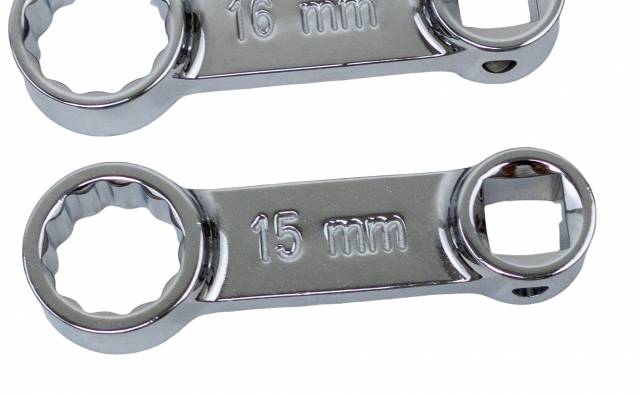
Installing engine manifolds, plumbing lines, or suspension fasteners where a standard socket won't fit? Follow this professional workshop procedure to calculate torque adjustments or set 90-degree adapter angles using the ATC CAA0270 metric adapter set.
Why Ignoring Torque Adapter Lever Offset Ruins Fasteners
Applying critical fastener torque in restricted spaces requires an understanding of basic leverage physics. When a torque wrench clicks or beeps, it measures the rotational torque applied at its drive square. If you attach a torque adapter extending straight out along the wrench handle line (0-degree inline extension), the extra distance increases the leverage arm acting on the fastener. If you set your torque wrench directly to the factory torque specification without adjusting for this extra length, the actual torque applied to the fastener will be significantly higher than intended—stretching bolts past yield, stripping aluminum threads, or warping gasket flanges. Conversely, if you position the adapter at a 90-degree angle relative to the wrench handle, the effective lever length remains unchanged, allowing you to set the wrench directly to target torque. Utilizing the ATC CAA0270 adapter set with correct angle orientation or formula calculations guarantees exact clamping loads on every bolt.
The 5-Step Torque Adapter Application Protocol
- Select the Correct Adapter Size: Match the required metric adapter from the ATC CAA0270 kit (10mm to 19mm) to the fastener hex. Verify that the 12-point box end seats 100% flush against the fastener shoulder.
- Determine Adapter Orientation (Inline vs. 90-Degree): Check surrounding clearance in the engine bay. If space permits, position the adapter at a 90-degree angle relative to the torque wrench beam to eliminate the need for mathematical recalculations.
- Calculate Adjusted Torque (If Inline Extension Used): If the adapter must extend straight inline with the torque wrench, calculate adjusted wrench torque ($T_w$) using the standard formula: $T_w = (T_f \times L) / (L + E)$, where $T_f$ is target fastener torque, $L$ is torque wrench length from handle center to drive square, and $E$ is adapter center-to-center offset length.
- Set Wrench & Execute Smooth Pull: Dial the calculated or target torque setting into your calibrated 3/8" drive torque wrench. Pull the wrench handle smoothly and steadily in a continuous motion until the wrench clicks or signals target torque.
- Verify Fastener Seat & Inspect Alignment: Check that the adapter did not bind against adjacent casting bosses or plumbing lines during the pull, which could cause false torque readings. Store the adapter back in the blow-molded case after use.
PRO-TECH TORQUE ADAPTER CALCULATION MANDATE:
Always pull torque wrenches smoothly from the center of the handle grip! Pulling off-center or applying force at an angle to the wrench beam alters effective lever length and skews click accuracy. When using adapters at 90-degree angles, re-verify that the adapter remains perpendicular to the wrench throughout the entire pull stroke.
3/8" Drive Precision. Complete 10mm–19mm Metric Coverage.
Get Your Metric Torque Adapter Set Now
overall rating:
my rating:
log in to rate