
Blog
Stop Rear Main Oil Leaks Before They Start: Why the JT30040B is Critical for John Deere 4045 Engine Protection
A rolled lip or 0.5mm depth error is all it takes to ruin a 4045 rebuild — here's how to prevent it.
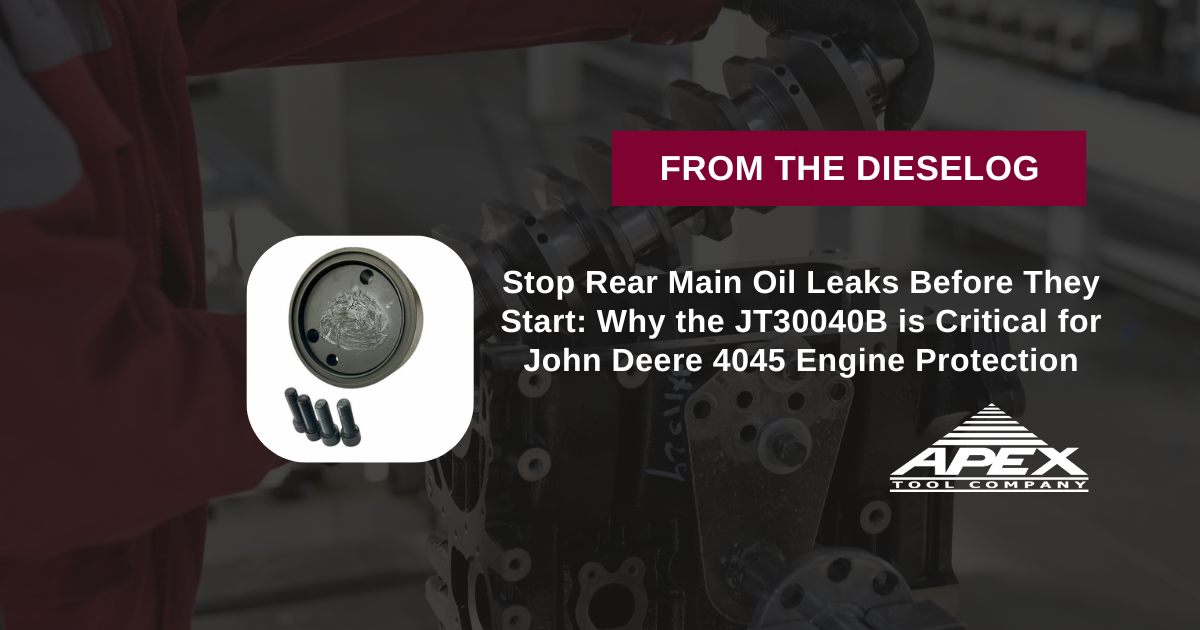
A rolled lip, a crooked seat, a 0.5mm depth error — that's all it takes to turn a routine rear main seal job on a John Deere 4045 into a costly comeback. The JT30040B is the precision tool that ensures it never happens.
The True Cost of a Rear Main Seal Failure
The rear crankshaft seal is the last line of defense between pressurized engine oil and the dry side of your John Deere 4045 — the flywheel housing, the clutch, and ultimately the transmission bell. When that seal fails after a sloppy install, it doesn't just weep a few drops on the shop floor. It contaminates the clutch friction surface, soaks the flywheel, and forces a complete teardown of components you just buttoned up. One avoidable installation error can mean four extra hours of labor, a ruined clutch disc, and a customer who never books with you again.
- Engine oil contamination of clutch components: Even a slow leak migrates onto the flywheel face within hours of running, glazing the disc and destroying friction coefficient.
- Pulled-transmission rework: Once oil reaches the bell housing, the only fix is a full driveline pull — the same job you just finished, billed at zero.
- Reputation damage on warranty work: A 4045 leaking from the rear main 200 hours after a rebuild is the kind of repair customers tell other operators about.
- Crankcase pressure misdiagnosis: A poorly seated rear main can be mistaken for blow-by, sending technicians chasing rings and PCV when the real fault is a lifted seal lip.
- Lost downtime on a 5075E in season: A leaking 5075E pulled out of hay or planting is a four-figure economic hit per day for the operator.
Why the JT30040B is the Insurance Policy on Every 4045 Rear Main Job
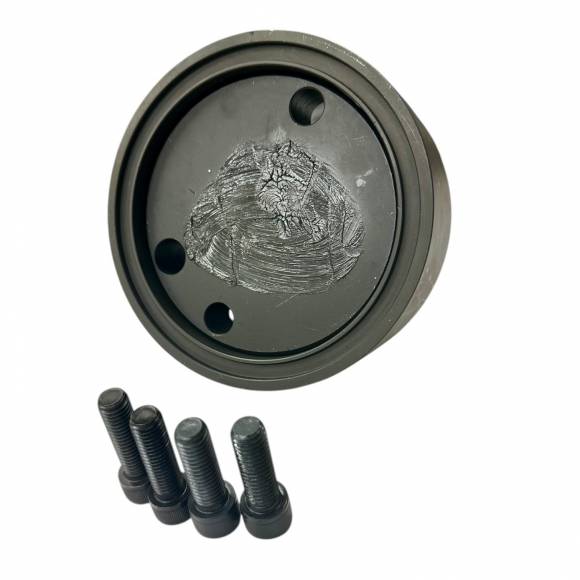
The JT30040B Rear Crankshaft Seal Installer isn't a "nice to have" tool you grab for difficult jobs — it's the baseline that turns rear main seal installation from a high-risk operation into a controlled, repeatable procedure. The tool is engineered with a precision-machined contact face that bears evenly across the entire seal body, eliminating the localized loading that causes lip distortion when a hammer-and-block, socket, or universal driver is used. It controls depth so the seal lands at the engineered position relative to the crankshaft sealing surface — not 1mm proud, not 1mm sunk. It maintains square-to-bore alignment automatically, removing technician variability from the most failure-prone step in the entire rebuild.
For a $325 capital cost — less than a single hour of labor on a botched rear main repair — the JT30040B pays for itself the first time it prevents a comeback. After that, it's pure margin protection on every 4045 and 5075E job that rolls through your bay.
The Five Failure Modes the JT30040B Eliminates
To understand why a dedicated installer matters, you need to understand the five specific ways rear main seal installation fails — every one of them avoidable with the correct tool.
1. Cocked Seat (Out-of-Square Installation). When a seal goes in even half a degree off-axis, the lip contacts the crankshaft journal unevenly. One side runs hot, the other runs slack. Within 50 hours of operation, the high-load side burns through the lip rubber and oil starts weeping. The JT30040B's full-circumference contact face physically prevents this — it cannot be driven cocked.
2. Rolled or Folded Lip. The garter spring inside a modern lip seal is delicate. If the seal slides over the crankshaft hub at the wrong angle, or if a sharp edge catches the rubber, the lip rolls inward, the spring jumps its groove, and the seal is finished before the engine ever turns. A correct installer applies force only on the metal case of the seal, never on the lip itself.
3. Over-Insertion (Too Deep). Drive a rear main too deep and it sits past the wear track on a used crankshaft, riding on a worn groove instead of fresh metal. Result: instant leak. The JT30040B is dimensioned to bottom out at the correct factory depth.
4. Under-Insertion (Standing Proud). A seal that isn't fully seated leaves a gap behind the case where oil pools and weeps past. It also can interfere with the flywheel face on John Deere applications where rear clearance is tight.
5. Localized Deformation of the Seal Case. Universal drivers and socket-on-block techniques apply force to two or three contact points instead of the full circumference. The metal case ovalizes, the lip distorts to match, and a seal that should run 8,000 hours fails at 800.
Real-World Case Scenarios From the Shop Floor
Scenario 1 — The Comeback That Cost the Job. A regional ag dealer rebuilt a 4045T out of a 5075E tractor. The rear main was tapped in with a wood block and dead-blow hammer — the way it had been done for thirty years. The tractor went home, ran 90 hours during second cutting, and came back with oil all over the bell. The clutch was glazed beyond saving. The dealer ate $1,400 in parts, 12 hours of labor, and a customer who switched to a competitor. Cost of a JT30040B that would have prevented it: $325.
Scenario 2 — The Fleet That Standardized. A municipal fleet running 4045-powered backhoes, generators, and skid loaders standardized rear main installation on the JT30040B across all three of their shop locations. Rear main warranty claims dropped from 7 per year to 0 within the first 18 months. Annualized labor savings: roughly $9,800. The tool paid for itself in under three months and has been generating margin every quarter since.
Scenario 3 — The Owner-Operator Save. An independent diesel mechanic working on a 5075E in his own shop borrowed a JT30040B from his parts supplier rather than improvising. The seal went in square, to depth, first try. The tractor went home leak-free and he kept the customer for the next three engine jobs. Sometimes the right tool is just about not making the mistake everyone else makes.
When and Why Rear Main Seals Get Replaced
Knowing when a rear main seal job is on the horizon helps you plan tooling. On the John Deere 4045 platform — which spans tractors, skid loaders, generators, sprayers, and industrial powerunits — the rear main is replaced at four predictable touchpoints:
Engine Overhaul or Rebuild. Any time the crankshaft is removed, replacing the rear main is mandatory practice. Reusing a seal that has already worn a track on the old crank is asking for a leak.
Clutch Replacement on Tractor Applications. With the transmission already split for a clutch on a 5075E, installing a fresh rear main costs $30 in parts and 15 minutes of labor — and prevents a second teardown a year later.
Diagnosed Rear Main Leak. Once the leak is visible at the bell, the seal is the cheap fix. The cost is the labor to access it.
Preventive Replacement at High Hours. Fleet operators running 4045s past 8,000 hours often schedule a preventive rear main during a planned downtime window rather than gambling on an in-service failure.
Every one of these touchpoints is a JT30040B job. A shop that does even one rear main replacement per quarter on this platform is leaving money on the table without one.
Fleet-Level ROI: The Numbers Behind the Tool
Run the math on a fleet shop performing 8 rear main installations per year on John Deere 4045 platforms — a conservative number for any operation servicing ag, industrial, or generator customers.
Without the JT30040B: Industry data on rear main installation comebacks runs between 8% and 15% when improvised tooling is used. At 10% and 8 jobs per year, that's roughly one comeback annually. A typical comeback on a 4045 — labor to split the driveline, clean and inspect clutch components, replace the contaminated clutch, install a new seal, and reassemble — averages between $1,200 and $1,800. Add customer-relationship cost, and the all-in is north of $2,000.
With the JT30040B: Comeback rate on properly installed rear mains drops to near zero when the tool is used correctly. The capital outlay of $325 is recovered on the first prevented comeback, and continues to deliver margin every job thereafter. Over a five-year service life — a deliberately conservative estimate for a heavy-duty steel installer — the tool can prevent five-figure losses.
The JT30040B is not a cost. It is a hedge against the single most expensive avoidable mistake in 4045 engine service.
Frequently Asked Questions
Q: Will the JT30040B work on every John Deere 4045 variant?
The JT30040B is designed for rear main seal installation on John Deere 4045 engines and the 5075E tractor platform. Across the broader 4045 family — including 4045T, 4045D, 4045HF, and PowerTech variants — the rear main seal interface is consistent enough that the tool covers virtually every common rebuild scenario on this engine.
Q: Can I use the JT30040B on the front crankshaft seal?
No. Front and rear crankshaft seals are different diameters, depths, and case dimensions. Use a dedicated front installer for the front seal and the JT30040B exclusively for the rear main.
Q: Do I need a press, or can I use a hammer?
The JT30040B is designed to be driven with controlled hand pressure or a soft-faced mallet. The tool transfers force evenly to the seal case so the installation is consistent regardless of the drive method. Never strike the tool with a steel hammer.
Q: Should I lubricate the seal lip before installation?
Yes. A light film of clean engine oil on the seal lip and crankshaft sealing surface is standard practice. Never use grease — it can compromise the lip during initial start-up.
Q: How long does the JT30040B last?
The tool is heavy-duty steel construction designed for professional shop use. Properly cared for, the JT30040B will outlast hundreds of seal installations.
Q: What about non-John Deere 4045 applications — does the same tool work on Cummins or Cat?
No. Different engine platforms use different seal dimensions and housing geometries. The JT30040B is purpose-built for the John Deere 4045 / 5075E rear main interface. Use platform-specific tools for other engines.
Q: Does Apex offer technical support if I have questions during a job?
Yes. Apex Tool Company technical support is available Monday through Friday, 8 a.m. to 5 p.m. ET at 812-579-5478 or 800-365-2233.
Q: What's included with the JT30040B?
The tool ships ready to use, in stock, at $325.00 with a shipping weight of 7.40 pounds. Free shipping is included on US continental orders over $500.
Don't Gamble With Rear Main Installation
The JT30040B — $325.00, In Stock, Heavy-Duty Steel — protects every 4045 and 5075E job that rolls through your bay.
SHOP THE JT30040B — $325📞 812-579-5478 / 800-365-2233 | Mon–Fri 8 a.m.–5 p.m. ET |
overall rating:
my rating:
log in to rate