
Blog
Drivetrain Insurance: Why the W950589006100 is Critical for Detroit Diesel DD13 / DD15 DT12 Clutch Service
A misaligned clutch is the most expensive mistake in DT12 service — and the easiest to prevent.

A misaligned clutch on a DT12 automated manual transmission doesn't just slow down a job — it destroys input shafts, eats new clutch packs, and turns a routine R&R into a four-figure comeback. The ATC W950589006100 is the single tool standing between a clean install and a costly mistake.
The Hidden Cost of "Close Enough" Clutch Alignment
On a Detroit Diesel DD13 or DD15 paired with a DT12 automated manual transmission, the input shaft has to slide through the clutch disc hub and into the pilot bearing with zero deflection. The DT12's tolerances are tighter than the legacy manuals it replaced, and the actuator that engages the clutch has no patience for a disc that's even a few thousandths off-center. Eyeballing the alignment — or worse, shoving the transmission home and hoping for the best — is the single fastest way to crack a pilot bearing, gall a splined hub, or warp a brand-new clutch pack before the truck ever leaves the bay. The W950589006100 eliminates that risk entirely.
What the W950589006100 Protects You From
- Pilot bearing destruction: A disc that sits even 1–2 mm off-center will side-load the pilot bearing the moment the transmission is bolted up, leading to premature seizure and bell-housing contamination.
- Splined hub damage: Forcing a misaligned input shaft through the clutch disc rounds off splines on both sides — turning a $1,200 clutch kit into scrap before it carries a single mile of load.
- DT12 actuator stress: The DT12's electronic clutch actuator monitors travel and load. A misaligned clutch sends false-load signals, triggering fault codes and accelerated actuator wear.
- Driveline vibration: An off-center disc creates a rotating imbalance the entire driveline has to absorb — felt as a steady-state shudder that customers will absolutely come back about.
- Repeat R&R labor: Pulling a DD13/DD15 transmission a second time costs 8–12 billable hours your shop will likely have to eat.
Engineered to OEM Spline and Pilot Dimensions
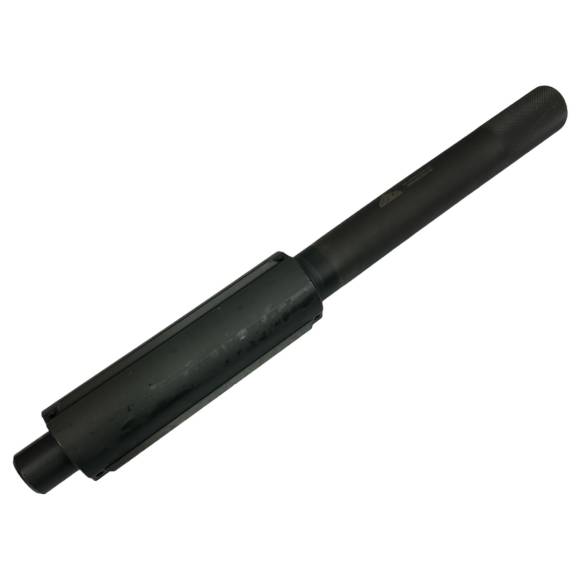
The ATC W950589006100 is machined to match the exact spline count, spline pitch, and pilot bore diameter of the DT12 input shaft as specified for DD13 and DD15 applications. That precision is what separates a real alignment tool from the "universal" plastic dummy shafts that float around shops — those generic tools center on the disc hub but ignore the pilot bore, which is exactly where DT12 systems fail. By referencing both surfaces simultaneously, the W950589006100 gives the technician a true, repeatable centerline every time. Drop it in, snug the pressure plate down, pull it out — the disc is now indexed exactly where the input shaft will land.
Failure Modes You're Insuring Against
Detroit Diesel DT12 service literature is explicit: clutch alignment must be verified with the correct alignment tool prior to torquing the pressure plate to spec. The reason is mechanical, not bureaucratic. The DT12 input shaft is supported by the pilot bearing at one end and the front bearing of the transmission case at the other. Any lateral load introduced by a misaligned clutch disc cantilevers across that input shaft as a bending moment. Over miles, that bending moment fatigues the input shaft splines, hammers the pilot bearing race, and translates into a rhythmic clunk under load that no balancing job will fix.
The most common in-the-field failure mode is harder to spot up front: a clutch that engages cleanly on the lift but begins to chatter or shudder once the truck is loaded and the driveline twists under torque. By the time that complaint comes back to the bay, the disc facings are usually glazed, the pilot bearing is dry, and the input shaft splines show wear they shouldn't have at that mileage. Every one of those failures traces back to an alignment that was off at install. The W950589006100 closes that loop.
There's a second, subtler failure pattern worth flagging — the slow-burn clutch death. A disc that's only slightly misaligned can survive the first thousand miles of moderate-duty driving without obvious symptoms. The damage accumulates invisibly: pilot bearing race fatigue, micro-pitting on the input shaft splines, and uneven thermal cycling at the disc facing. By the time the truck returns at 30,000–50,000 miles with a complaint, the entire drivetrain has absorbed thousands of cycles of side-load, and the customer has every reason to believe a "new" clutch shouldn't be failing. Disputes over warranty coverage in those scenarios almost always trace back to alignment that was never verified at install.
What Makes the DT12 Different from a Legacy Manual Transmission
Technicians who came up on legacy Eaton manual transmissions sometimes carry over assumptions that no longer apply on the DT12. A traditional driver-engaged manual clutch tolerates a certain amount of alignment drift — the human foot smooths over imperfections through engagement modulation, and the input shaft has more lateral compliance than DT12 systems allow. The DT12 inherits none of that forgiveness. Its actuator is a precision electromechanical device that engages and disengages the clutch on a programmed travel curve, with feedback sensors verifying that the clutch behaves as expected at every position in its range. A misaligned disc throws the engagement profile out of spec — the actuator sees higher-than-expected loads at certain travel positions, logs it as a fault condition, and over time can flag the clutch system as needing service even when the friction surfaces are still within wear limits. That's a failure mode that simply didn't exist on legacy manuals, and it's another reason the W950589006100 has become standard equipment in shops doing DT12 work.
The Dry-Start and Break-In Window
The first hours of operation after a clutch replacement are the most demanding period in the drivetrain's life. The pilot bearing is fresh, the disc facings are bedding in, and the input shaft splines are establishing their wear pattern. If alignment is correct, the components seat together within the first few hundred miles and settle into a stable wear profile that lasts the life of the clutch. If alignment is wrong, those same first hours embed the misalignment into every component permanently — the pilot bearing race takes on a slight off-axis wear pattern, the disc facings glaze unevenly, and the splines develop high-spot wear that worsens with every shift. There is no recovery from a bad break-in on a DT12 clutch; the only correction is a full teardown and re-do. The W950589006100 ensures the break-in window starts with the geometry exactly where it needs to be.
Real-World Scenario: The $4,000 Comeback
A regional fleet shop installs a new clutch kit and reman DT12 in a DD15-powered Cascadia. The tech, working without the proper alignment tool, sights the disc by eye and torques the pressure plate. The transmission goes back in with a fight — splines bind, the bell housing seats with a noticeable gap that gets pulled in with bolts (red flag #1). The truck leaves the shop. Eleven hundred miles later it returns with a vibration complaint, fault codes for clutch slip, and a driver report of difficult shifts at highway speed. The repeat job: pull the transmission again, replace the now-damaged clutch disc and pilot bearing, dress the input shaft splines, requalify the actuator. Parts and labor run north of $4,000, none of which is recoverable from the original ticket. A $275 alignment tool would have eliminated the entire incident.
Where the W950589006100 Fits in Your Service Schedule
Any time the transmission separates from the engine on a DD13 or DD15 with a DT12, the alignment tool comes out of the drawer. That includes scheduled clutch replacement (typically 400,000–500,000 mile range depending on duty cycle), pilot bearing service, rear main seal replacement, flywheel resurfacing or replacement, transmission overhaul, and any major engine R&R that requires bell-housing separation. There is no DT12 clutch service in which this tool is optional. Building it into your standard work order ensures every tech, every shift, follows the same alignment procedure — which means consistent install quality regardless of who's on the job.
For shops that handle mixed Detroit Diesel work — DD13s, DD15s, occasionally DD16s, and the surviving Series 60 fleet still in operation — the W950589006100 sits at the front of the alignment-tool drawer because DT12 jobs make up the bulk of modern clutch work in that lineup. Pairing it with a flywheel installer/remover, a pilot bearing puller, and the appropriate pressure plate alignment dowel set gives a shop a complete dedicated DT12 clutch tool kit. That kit eliminates the on-the-fly improvisation that creeps in when a tech is missing one piece and decides to "make it work" with whatever is available — improvisation that, on a DT12, is precisely what the W950589006100 was designed to prevent.
Fleet-Level ROI: Why $275 is the Cheapest Insurance You'll Buy
Run the math on a fleet shop that performs even 6 DT12 clutch jobs per year. A single misaligned install that comes back as a warranty job — clutch kit, pilot bearing, labor, downtime — easily clears $3,500–$4,500 in unrecoverable cost. The W950589006100 amortizes against the first prevented comeback inside 30 days of ownership, then continues paying back across every subsequent job for the life of the tool. Over a five-year service life with a single-tool shop, the prevented-failure savings can exceed $20,000 — and that's before accounting for the customer-relationship cost of a fleet truck that goes back to the road and breaks down 1,000 miles later. The W950589006100 isn't an expense line; it's the cheapest piece of risk reduction in the bay.
Customer Retention: The Unbilled Cost of a Bad Install
The dollar cost of a comeback is just the visible piece of the iceberg. The bigger cost is the conversation a fleet manager has after the second breakdown — the one where they start pricing out other shops. Trucks that fail repeatedly under warranty become the reason fleets switch service providers, and the switching cost for the shop that loses the account dwarfs any single repair ticket. A $275 alignment tool isn't just protecting against the warranty job; it's protecting against the year-over-year revenue from that customer's entire fleet. Shops that have done the math on customer lifetime value treat the W950589006100 the way they treat their primary lift — non-negotiable equipment that pays for itself many times over.
Standardizing the Procedure Across Every Tech in the Shop
Shops with three or more techs working DT12 clutch jobs face a quality-control problem that single-tech shops don't: every technician brings their own habits to the work. Some are meticulous about alignment; others have been getting away with eyeball installs for years. Without a standardized tool and procedure, the quality of the install — and the comeback rate — varies by who's on shift. Adding the W950589006100 to the standard work order for every DT12 clutch job eliminates that variability. The tool itself enforces the procedure: it either fits or it doesn't, the disc is either centered or it's not. Documentation can require the alignment tool to be referenced on the work order before pressure plate torque is signed off. That single shop-management change converts an inconsistent procedure into a repeatable one, and converts comeback rates from a function of who installed the clutch into a function of nothing at all.
Training the Next Generation of Diesel Technicians
Apprentice and entry-level technicians benefit enormously from working with the right precision tooling from day one. A new tech learning DT12 clutch service with the W950589006100 internalizes the correct procedure as the only procedure they know — the tool defines the standard. A new tech learning without it picks up the bad habits of whichever senior tech happens to be training them, and those habits propagate through the shop for years. Investing in the right alignment tool is, in part, an investment in workforce development. It's also an investment in the shop's reputation: customers who watch a tech work with proper specialty tooling form an impression of professionalism that carries over into every interaction with the service department, while customers who see a tech eyeballing critical procedures form the opposite impression. The $275 price tag of the W950589006100 buys both correct alignment and the visible signal that the shop takes its work seriously.
Frequently Asked Questions
Q: Will the W950589006100 work on the older Detroit Diesel Series 60 with manual transmissions?
A: No. The W950589006100 is specifically machined to match DT12 input shaft dimensions on DD13 and DD15 engines. Series 60 manuals use a different spline count and pilot diameter and require the corresponding tool for that platform.
Q: Can I use a generic plastic alignment tool instead?
A: Generic tools center the disc hub but rarely match the pilot bore correctly, which is the critical reference surface on DT12 systems. The result is a disc that looks centered but isn't truly indexed to where the input shaft will land. The W950589006100 is the only way to verify both surfaces at once.
Q: How is this tool used on the bench versus in the truck?
A: It works the same in both environments. With the flywheel mounted, insert the W950589006100 through the clutch disc and into the pilot bore, snug the pressure plate down to seat the disc against the alignment tool, then torque the pressure plate to OEM spec and remove the tool.
Q: How do I know if I have a DT12 transmission?
A: The DT12 is the Detroit Diesel automated manual transmission used in Freightliner Cascadia and Western Star applications behind DD13 and DD15 engines. It carries a Detroit Diesel data tag and is identifiable by the electronic clutch actuator mounted on the bell housing.
Q: Does the tool require any maintenance?
A: Keep it clean and lightly oiled to prevent corrosion. Store it in a dedicated location — not loose in a drawer where the spline pilot can get nicked. A nicked pilot reduces alignment accuracy and shortens tool life.
Q: Is the W950589006100 the OEM tool or an equivalent?
A: The W950589006100 is engineered to match OEM spline and pilot dimensions for DD13/DD15 DT12 applications. It performs identically to the OEM-spec tool at a price built for everyday shop use.
Q: How long does the W950589006100 last in regular shop use?
A: With proper storage and care, the tool will service thousands of clutch installations. Wear is concentrated on the pilot tip; inspect it regularly and replace the tool if you see measurable wear or damage on the spline.
Q: What happens if I skip the alignment tool altogether?
A: You're gambling against tight DT12 tolerances. Some installs may go together cleanly without the tool, but the failure rate climbs significantly — and the cost of even one comeback exceeds the price of the tool many times over.
Stop Gambling on Clutch Alignment
Get the tool that keeps DT12 jobs from coming back. In stock — $275.00 — free shipping over $500.
Order the W950589006100 →Apex Tool Company • 812-579-5478 / 800-365-2233 • Mon–Fri 8 a.m.–5 p.m. ET
overall rating:
my rating:
log in to rate