
Blog
Why the ATCZTSE4516 is Critical for Ford 6.0L Power Stroke Front Seal Service
Why a $145 installer is the cheapest insurance policy you'll ever write against 6.0L front seal comebacks.
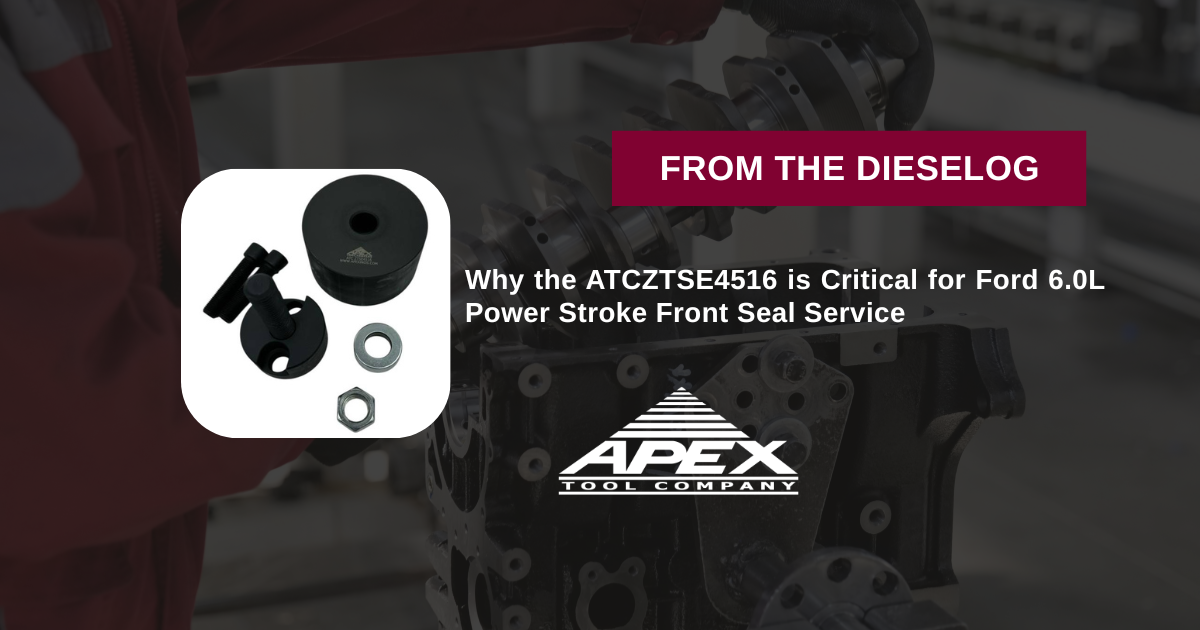
A botched front crankshaft seal job on a 6.0L Power Stroke doesn't just leak oil — it eats your shop's margin, your customer's trust, and your reputation. Here's why the right installer pays for itself on the first job.
The Hidden Cost of a $30 Front Seal
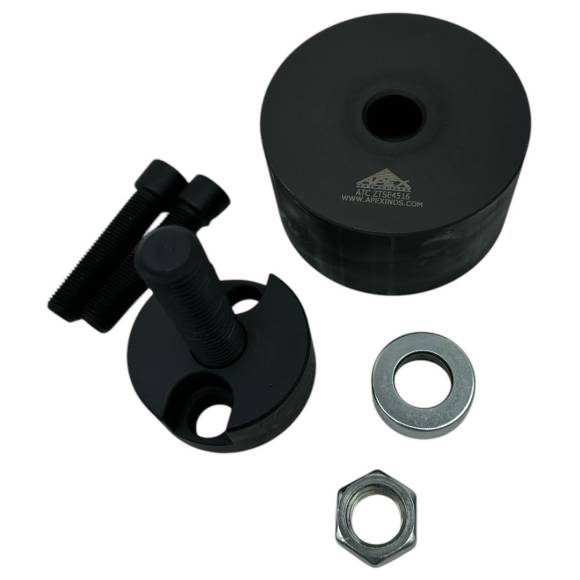
On a Ford 6.0L Power Stroke, the front crankshaft oil seal sits between the crankshaft snout, the harmonic balancer, and the engine's oil cavity — a high-pressure, high-rotation interface that punishes any installation shortcut. A seal that's cocked, distorted, or driven past OEM depth will weep, then leak, then ruin the wear ring. The customer comes back. The job comes apart. And the comeback eats three to four billable hours of labor that should've gone to the next ticket. The ATCZTSE4516 Front Crankshaft Seal & Wear Ring Installer exists for one reason: to keep that job from ever bouncing back.
- Seals Stay Straight on the First Hit: Precision-machined bore and pilot drive the seal square to the crank centerline — no cocking, no lip rolls, no shortcut hammer marks.
- Wear Ring Sets to OEM Depth, Every Time: The installer indexes off the crank snout so the wear ring lands at the factory-correct seating depth on every job, not "close enough."
- Direct Replacement for Ford 303-761 / ZTSE-4516: Same function, same fitment, same procedure as the dealer tool — without the dealer tool price tag.
- Heavy-Duty Steel That Survives a Fleet Calendar: Built for repeated professional use; no deformation after the tenth, twentieth, or hundredth pull-up.
- Comeback Insurance Built Into Every Installation: Eliminate the #1 cause of repeat front seal jobs — cocked or improperly seated seals from improvised installation methods.
Why Generic Tools Cost You More Than the ATCZTSE4516 Ever Will
Walk through any independent diesel shop and you'll find the same improvised solutions: a deep socket, a brass drift, a section of PVC pipe, a block of hardwood, sometimes just a rag wrapped around a hammer face. Every one of those workarounds shares the same fundamental flaw — there is no way to guarantee the seal travels square to the crankshaft centerline. On a 6.0L Power Stroke, where the front cover, harmonic balancer hub, and crankshaft snout all stack tolerances against each other, "square enough" doesn't seal.
The ATCZTSE4516 is precision machined so the driving surface contacts the seal's outer steel cage uniformly across 360 degrees. That uniform contact translates directly into uniform installation force — which means uniform sealing pressure once the engine sees oil and RPM. A seal driven with a deep socket gets force concentrated wherever the socket happens to bear. The lip rolls under, the steel case distorts, and the seal weeps within the first thousand miles. That weep is the comeback you don't want.
The wear ring installation is even less forgiving. Ford's 6.0L wear ring is a thin-walled sleeve that must press onto the crankshaft snout without scoring the underlying journal surface. Hammer it on with a brass drift and you risk three things: an out-of-round ring, a scored crank snout, and a wear ring that bottoms uneven against the timing cover oil seal — guaranteeing a leak before the truck leaves the lot. The ATCZTSE4516 pilots over the crankshaft and applies force only to the wear ring's leading edge, exactly where the engineering intends.
Failure Mode Deep Dive: What Actually Goes Wrong
Front crankshaft seal failures on the Ford 6.0L Power Stroke follow a predictable pattern, and almost every mode traces back to one of four installation errors. Understanding these failure modes is the first step toward eliminating them from your shop's repair history.
Cocked Seal Installation: When the seal enters the bore at any angle other than perpendicular to the crankshaft, the lip contacts the shaft unevenly. Initially the leak may be intermittent — a few drops after a hot shutdown — but as the elastomer fatigues, the weep becomes a steady drip. Diagnosis is almost always visual: an asymmetric oil stain on the front cover. Resolution requires complete repeat of the front seal R&R procedure.
Over-Driven Depth: Driving the seal past its OEM seating depth pushes the lip beyond the wear ring's polished sealing surface and onto the rougher transition area of the crank snout. The seal lip wears prematurely, often within 8,000 to 15,000 miles, producing a slow leak that customers blame on the new seal — not on the install method.
Wear Ring Scoring: Driving the wear ring with a punch or brass drift will leave score marks on the crank snout. Those marks become stress risers and oil migration paths. Once present, they cannot be polished away without machining the crank snout — a job that requires removing the engine.
Wear Ring Cocking: A wear ring driven crooked sits unevenly under the seal lip, creating a continuously varying sealing diameter as the crank rotates. The result is a leak that no replacement seal will ever fix — the wear ring itself has to come off and be replaced, doubling the labor on what should have been a routine job.
Real-World Comeback Scenarios From the Shop Floor
Talk to any fleet maintenance manager running a fleet of 6.0L Power Stroke E-Series vans or Super Duty pickups, and they'll tell you the same story: the front crankshaft seal is one of the top three "preventable comeback" items on the engine. Here's what those comebacks look like in real shop terms.
Scenario 1 — The Two-Week Weep: A 2006 F-350 6.0L comes in for a front timing cover gasket. The tech replaces the gasket, drives in a new front seal with a deep socket, and sends the truck out. Two weeks later, the customer is back with oil dripping off the harmonic balancer onto the alternator. Labor to re-do: 3.5 hours. The seal cost $32. The wear ring cost $58. The comeback cost the shop $400+ in unbillable time and a customer who now tells everyone the shop "couldn't fix a leak."
Scenario 2 — The Scored Snout: A 2005 E-450 ambulance gets a wear ring installed with a brass drift. The drift slips, scores the crank snout, and the technician doesn't catch it. The ambulance returns six weeks later with a major front leak. The crank snout is now damaged beyond repair without engine R&R. Estimate to fix: $4,800+. The original job billed $380.
Scenario 3 — The Fleet Pattern: A municipal fleet runs nine 6.0L Power Stroke trucks. The in-house shop uses generic tools for front seal service during scheduled overhauls. Over 18 months, four of those nine trucks come back for front seal leaks. The fleet manager investigates, discovers the install method, and approves $145 for a dedicated installer. The comeback rate drops to zero across the next 24 months. Net savings: roughly $1,800 in unbillable warranty labor — on a $145 tool investment.
When Front Seal Service Becomes Mandatory
The front crankshaft seal isn't on a strict mileage interval, but several service events make replacement mandatory rather than optional. Any time the harmonic balancer is removed for timing cover service, front cover gasket replacement, water pump service requiring balancer removal, or oil cooler/oil pan repairs that involve front-of-engine disassembly, the front seal should be replaced as a matter of policy. Reusing an old seal after disturbing the wear ring interface is asking for a leak — and a comeback.
Engines with confirmed front seepage on inspection are obvious candidates. So are engines being prepped for resale or fleet redeployment, where any front-of-engine oil residue immediately devalues the asset in the buyer's mind. And any time a 6.0L is opened up for the well-known head gasket and EGR work, the front seal and wear ring are an easy add-on while the front of the engine is already accessible.
Fleet-Level ROI: The Math Most Shops Don't Run
For a multi-bay diesel shop or in-house fleet operation, the ROI on a dedicated installer like the ATCZTSE4516 is one of the easiest tool-purchase justifications to write up. The math goes like this.
Assume a moderate shop performs 12 front crankshaft seal services per year across the 6.0L Power Stroke platform — a conservative figure for any shop with Ford diesel customers. Industry comeback rates for front seal jobs using improvised tools sit between 8 percent and 15 percent. At a 10 percent comeback rate, that's roughly 1.2 comebacks per year, each costing 3 to 4 hours of unbillable labor. At a $125/hour shop rate, that's $450 to $600 per year in lost billable time on this one repair alone — and the figure doesn't account for parts thrown away, customer-relationship damage, or schedule disruption.
A dedicated installer eliminates the install-method variable from the failure equation. Comebacks drop to near-zero across years two through ten of the tool's service life. Total cost of the ATCZTSE4516: $145 once. Total return: thousands of dollars in protected billable hours over the tool's lifetime, plus the intangible value of a reputation for "fix it right the first time" work. For a multi-tech shop, the installer pays for itself before the second job is finished.
Frequently Asked Questions
Q: Is the ATCZTSE4516 a true direct replacement for the Ford 303-761?
A: Yes. The ATCZTSE4516 is a precision-machined aftermarket equivalent to Ford Rotunda tool 303-761 / ZTSE-4516. It uses the same pilot diameters, the same indexing surfaces, and the same installation procedure as the OEM tool.
Q: Will this tool work on all Ford 6.0L Power Stroke applications?
A: Yes. It covers all 6.0L Power Stroke installations — F-250, F-350, F-450, F-550 Super Duty (2003–2007), F-650 / F-750 (2004–2007), E-Series E-150 through E-450 vans (2004–2010), and Excursion (2003–2005).
Q: Do I still need the wear ring sleeve installer if I have a seal installer?
A: The ATCZTSE4516 handles both the front crankshaft seal and the wear ring installation. That dual function is exactly why this is the tool that replaces both the front seal installer and the wear ring installer in your front-of-engine service kit.
Q: Can I install the seal without first installing the wear ring?
A: No. The wear ring is the sealing surface that the seal lip rides on. A new seal installed against a worn or absent wear ring will leak almost immediately. Always replace both as a set on any 6.0L Power Stroke front seal service.
Q: What's the typical labor time on a 6.0L Power Stroke front seal job using this tool?
A: With the harmonic balancer already removed for adjacent service, the actual front seal and wear ring R&R takes 30 to 45 minutes for an experienced 6.0L technician. Total job time depends on what else is being accessed at the same time.
Q: Does Apex Tool Company stock this and can it ship today?
A: Yes. The ATCZTSE4516 is in stock at Apex Tool Company. Orders over $500 (continental US) ship free. Same-day shipping is standard for orders placed before the daily cutoff.
Q: How does this compare to buying the dealer tool 303-761 direct from Ford?
A: The OEM Ford Rotunda 303-761 is significantly more expensive and is functionally identical to the ATCZTSE4516 for front seal and wear ring installation. The Apex tool delivers the same OEM-correct installation depth and squareness for a fraction of the dealer price.
Q: Does the ATCZTSE4516 come with instructions?
A: The tool follows the standard Ford 303-761 installation procedure documented in Ford's service literature for the 6.0L Power Stroke. Any technician familiar with the OEM front seal service procedure will use this tool the same way the dealer uses theirs.
Stop Comebacks Before They Start
The ATCZTSE4516 Front Crankshaft Seal & Wear Ring Installer — just $145 — pays for itself the first time it saves you a comeback. In stock. Ships fast. Built for diesel professionals.
SHOP THE ATCZTSE4516 →📞 812-579-5478 | 800-365-2233 | Mon–Fri 8 a.m.–5 p.m. ET | Free shipping on orders over $500 (US continental)
overall rating:
my rating:
log in to rate