
Blog
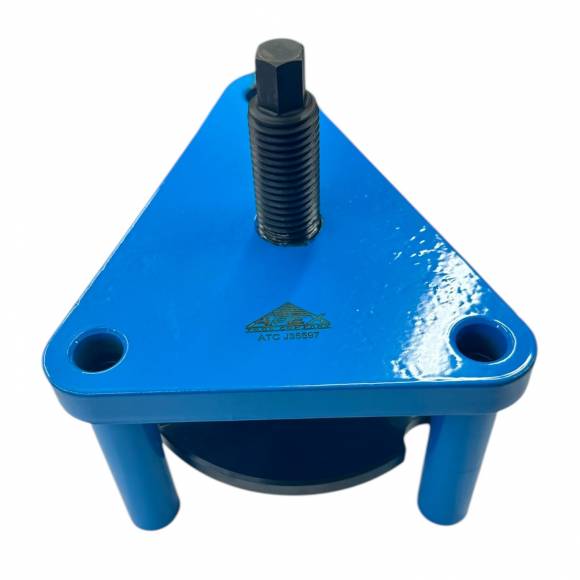
Engine Insurance in a Tool Box: Why the J-35597 is Critical for Detroit Diesel Series 60 Liner Installation
Why $180 in your tool box protects every Series 60 rebuild you'll ever do.

A single mishandled cylinder liner can transform a $25,000 engine rebuild into a $40,000 catastrophe. The J-35597 is the only insurance policy that pays out before the failure happens.
The Hidden Cost of "Close Enough" Liner Installation
Detroit Diesel Series 60 engines are workhorses — they pull freight across continents, run gensets through hurricanes, and log millions of miles in long-haul fleets. But every Series 60 has one non-negotiable demand during rebuild: its wet cylinder liners must be seated with surgical precision. When a technician improvises with hammers, drift punches, or a hydraulic press without the proper adapter, the consequences arrive within hours of startup. Coolant infiltrates the crankcase. The head gasket lifts. The cylinder bore goes oval under thermal stress. What started as a "shortcut" ends as a comeback that destroys shop margins and customer trust simultaneously.
- Eliminates O-Ring Damage on Entry: The J-35597's controlled-pressure design slides the liner past the lower bore seals without the pinching, rolling, or shearing that wrecks rubber and guarantees a coolant leak by the second heat cycle.
- Maintains Square Alignment in the Bore: Liners installed with a cocked tilt of even 0.005" will distort under combustion load, causing accelerated ring wear and oil consumption that no rebuild warranty will cover.
- Protects Critical Liner Protrusion Specs: Series 60 protrusion tolerance is measured in thousandths — the J-35597 seats the liner evenly so your dial indicator readings tell the truth, not a story of uneven force application.
- Heavy-Duty Construction for Repeat Production: Built for shops that rebuild Series 60s every week, not weekend warriors — the J-35597 holds tolerance across hundreds of cycles.
- Engineered to OEM Service Specifications: This is the tool Detroit Diesel's service literature references by part number — using it isn't a preference, it's the documented standard your warranty hinges on.
$180 to Protect a $25,000 Rebuild
Every shop owner knows the math intuitively but rarely says it out loud: the most expensive tool in the bay is the one that wasn't there when the technician needed it. The J-35597 Cylinder Liner Installation Tool sits at the absolute top of the cost-of-failure pyramid. A botched liner install on a Series 60 means pulling the head, pulling the liner you just installed, replacing destroyed O-rings, machining a scuffed bore if you're lucky, and re-doing eight hours of labor. At $180, the J-35597 is roughly the price of one labor hour on a rebuild ticket. Once. Forever.
The Anatomy of a Liner Installation Failure
To understand why the J-35597 matters, walk through what actually goes wrong without it. The Series 60 wet liner sits in a precision counterbore at the top of the block and is sealed at the bottom by two O-rings riding in dedicated grooves. When a technician taps the liner in with a brass drift, the force travels asymmetrically — heavier on the strike side, lighter on the opposite. The liner enters the bore at a microscopic tilt. As it travels down, the lower O-ring contacts the bore surface unevenly, rolls in its groove on one side, and sometimes shears clean against the chamfer edge.
The technician feels nothing wrong. The liner protrusion measures within spec because the dial indicator only catches gross deviation. The engine goes back together. Fluids fill. Initial fire-up looks clean. Twelve hours into a road test, the customer calls: white smoke, low coolant, oil-cap mayonnaise. The shop now owns a teardown that nobody is paying for. This is the failure pattern the J-35597 was specifically engineered to eliminate by applying axial force directly down the centerline of the liner, with a reaction surface that cannot tilt.
Real-World Scenario: The Fleet That Learned the Hard Way
Consider a regional trucking outfit running 40 Series 60-powered tractors. Their in-house shop performed an in-frame overhaul using a hydraulic press and a shop-built adapter plate. Within the first 30 days, three units returned with coolant-in-oil contamination. The shop traced the failure to lower O-ring damage on five of six liners pulled. Total cost across three engines: roughly $42,000 in re-work, plus 11 days of truck downtime at approximately $850 per truck per day in lost revenue. The J-35597 would have cost $180. The math, as they say, doesn't care about feelings.
Where the J-35597 Fits in Your Rebuild Workflow
The J-35597 is not a multi-purpose tool. It earns its place in your tool inventory at one specific moment in the Series 60 rebuild sequence — after the block is cleaned, after the counterbores are inspected and measured, after new O-rings are lubricated and seated in their grooves, and immediately before final torque on the head. At that moment, the liner must travel from above the deck down into the bore in one smooth motion, square to the deck, with the lower seals passing chamfer to chamfer without distortion. The J-35597 is the only tool that performs this operation correctly with a single technician.
For shops doing repeated Series 60 work — whether mainline freight, marine repower, generator service, or yellow-iron rebuild — the J-35597 belongs in a dedicated rebuild kit alongside your liner puller, protrusion gauge, and torque-to-yield wrench. It is not optional equipment. It is the difference between a clean rebuild and a comeback ticket.
Maintenance Schedule Context: When Liners Get Touched
Series 60 cylinder liners come out at major overhaul — typically between 750,000 and 1,200,000 miles depending on duty cycle and oil maintenance discipline. They also come out for repair scenarios: scored bores from coolant ingestion, dropped valve damage, or piston failure. Every time a liner is pulled, it must be replaced (Detroit Diesel does not approve liner reinstallation). Every replacement is a precision installation event. A shop running steady Series 60 volume will use the J-35597 dozens of times per year. A specialty rebuilder will use it weekly. The tool's economic life is measured in decades, not engines.
Fleet-Level ROI: What the J-35597 Actually Saves
For a fleet maintenance manager evaluating tool investment, the calculation is straightforward. Assume an in-house shop performs 12 Series 60 in-frames per year. Industry data suggests improper liner installation causes a comeback failure on roughly 3 to 5 percent of jobs done without the proper installer — call it one comeback every two years at the conservative end. A single comeback consumes approximately 16 hours of labor, $2,800 in destroyed parts (liner, O-rings, gaskets, possibly head work), and 5 to 8 days of downtime. At a fully-burdened shop labor rate of $145/hour and downtime cost of $850/day, one event is roughly $9,500 in direct cost plus another $5,950 in downtime impact. The J-35597 pays for itself approximately 86 times over on the prevention of a single failure.
Frequently Asked Questions
Q: Does the J-35597 work on all Series 60 displacement variants?
Yes. The J-35597 is engineered for the Detroit Diesel Series 60 family — including 11.1L, 12.7L, and 14.0L variants — which share common cylinder liner geometry across the line.
Q: Can I substitute a hydraulic press with a shop-built adapter?
Technically possible, practically inadvisable. A shop-built adapter cannot guarantee the axial force application and reaction geometry the J-35597 provides. The financial risk versus the $180 tool cost is impossible to defend on a job ticket.
Q: Is the J-35597 OEM-equivalent or aftermarket?
The J-35597 is a service tool built to the OEM specification referenced in Detroit Diesel service literature, designed for professional rebuild use.
Q: How long does liner installation take with this tool?
Once the block is prepped and O-rings are seated, a single liner installation with the J-35597 typically runs 5 to 10 minutes per cylinder — faster than any improvised method and dramatically more reliable.
Q: Does the tool require any consumables or wear parts?
The J-35597 is heavy-duty constructed for thousands of installation cycles with proper care. Keep it clean, lightly oiled when stored, and inspected for surface damage before each use.
Q: What's the shipping weight and lead time?
Shipping weight is 15 lbs. The J-35597 is currently in stock at Apex Industries with standard shipping timelines, and orders over $500 ship free within the continental U.S.
Q: Can one tool serve a multi-bay shop?
Yes. Most production shops cycle a single J-35597 across multiple rebuild stalls. For high-volume rebuilders running parallel stations, a second unit eliminates workflow bottlenecks.
Q: What other tools should accompany the J-35597 in a Series 60 rebuild kit?
A liner puller, liner protrusion gauge, counterbore measurement tool, and the appropriate torque wrench set for head bolts are the core companion tools for a complete Series 60 liner service.
Stop Gambling on Series 60 Rebuilds.
Get the J-35597 Cylinder Liner Installation Tool — the OEM-spec service tool that protects every liner job you'll ever do. Just $180.00 and in stock now.
SHOP THE J-35597 →📞 Talk to a tech: 812-579-5478 / 800-365-2233 · Mon–Fri 8 a.m.–5 p.m. ET
🚚 Free shipping on orders over $500 (US continental)
overall rating:
my rating:
log in to rate