
Blog
Stop the Drip Before It Costs You a Rebuild: Why the M20185 Is Critical Insurance for Every Cummins ISX12 & ISX15 Front Seal Job
OEM-Equivalent Insurance Against the Most Expensive Comeback in Cummins ISX Service
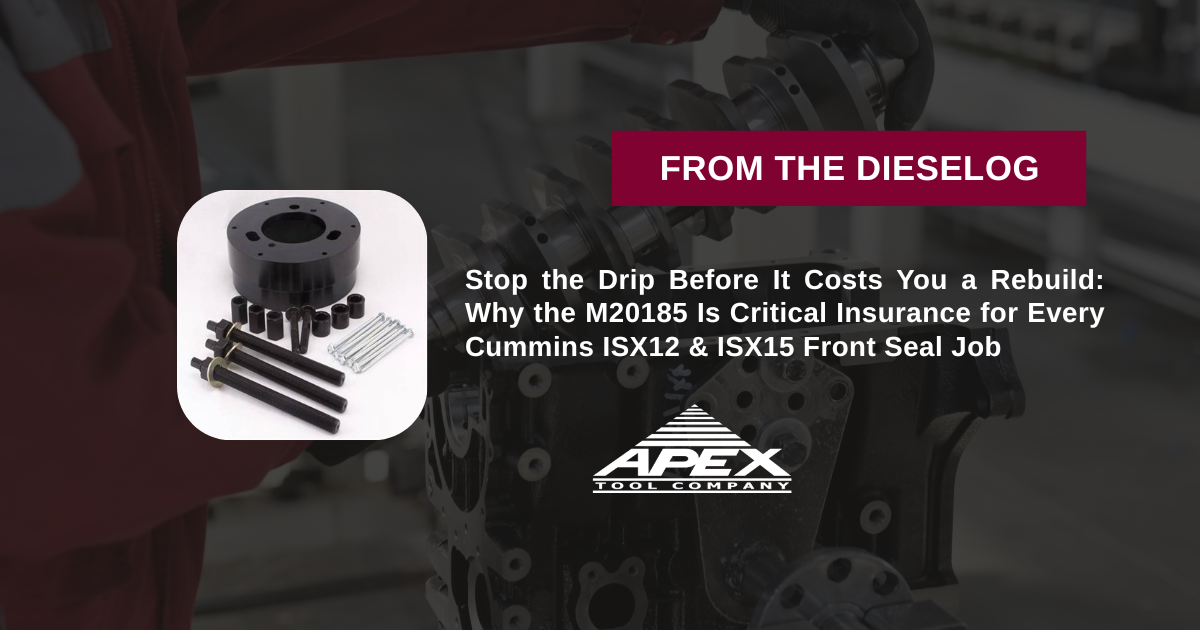
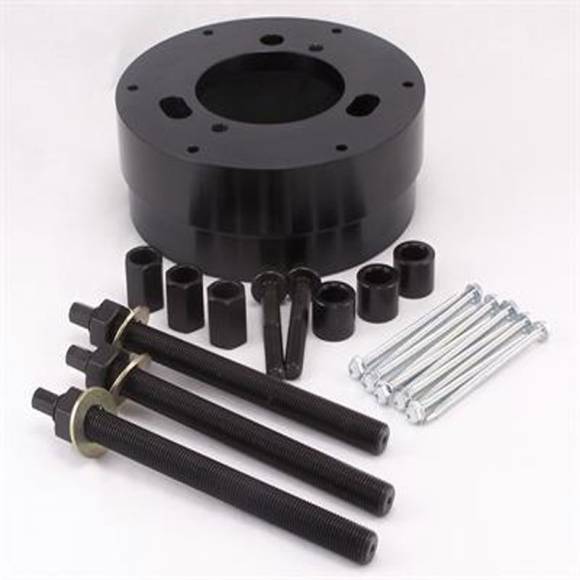
A single misseated front crankshaft seal on a Cummins ISX15 can drain oil onto the harmonic balancer, contaminate the front cover, and turn an afternoon repair into a multi-thousand-dollar comeback. The M20185 Front Crankshaft Seal Remover / Installer is the OEM-equivalent tool that protects your shop from that exact disaster — every single time.
The Real Cost of Skipping the Right Tool
Every veteran diesel technician has seen it: a freshly serviced ISX15 rolls out of the bay on Friday, and by Monday morning the driver is on the phone reporting oil pooling on the front timing cover. The culprit is almost never the seal itself — it is the way the seal was driven home. A cocked installation, a nicked sealing lip, or a fractionally over-driven depth all create leak paths that ruin the repair. The cost of pulling the damper a second time, sourcing another seal, and absorbing the customer's lost runtime dwarfs the price of the correct installation tool many times over.
- ✓Direct OEM-equivalent for Cummins 4918991: Built to the exact engineering spec required for ISX12 and ISX15 service, so torque points, depth control, and pilot fit match the factory procedure.
- ✓Zero seal-lip damage: Controlled pilot geometry guides the new seal over the crank nose without rolling, cutting, or distorting the sealing lip — the #1 cause of premature comebacks.
- ✓Concentric, repeatable seating: The tool indexes the seal square to the crankshaft centerline every time, eliminating the human error baked into hammer-and-socket improvisation.
- ✓Shop-and-field durability: Built from hardened components rated for repeated cycle use across overhauls, roadside repairs, and high-volume fleet service.
- ✓Comeback insurance: One avoided rework on a Class 8 fleet truck pays for the tool — often several times over.
Why the M20185 Is Worth Every Dollar — and Then Some
At $372.65, the M20185 Front Crankshaft Seal Remover / Installer is priced as a working shop tool, not a luxury. But the math gets interesting when you compare it to what a single botched front seal job costs in a real-world heavy-duty service environment. A returning ISX truck consumes a bay, ties up a tech, requires a fresh OEM seal, may need a new gasket on reassembly, and absorbs hours of warranty labor your shop will never bill out. Add a possible damper inspection, and a single comeback can pencil out north of $1,200 in absorbed cost — before the customer's downtime is even considered.
The M20185 is the tool that prevents that scenario from being possible. It is the exact functional equivalent of the OEM Cummins 4918991 specified for ISX12 and ISX15 front crankshaft seal service, which means it works with the procedure your techs already know. No retraining. No workaround. No improvisation with sockets, drift punches, or "that thing in the bottom drawer that kind of fits." Just the correct tool, every time, indexed to the correct depth on the correct centerline.
Inside an ISX Front Seal Failure: How a Tiny Leak Becomes a Catastrophe
Front crankshaft seal leaks on Cummins ISX engines rarely announce themselves dramatically. A pin-drip starts behind the damper. Oil migrates outward under rotational airflow and gets thrown onto the serpentine belt, the front accessory drive, and the bottom of the radiator. The driver sees nothing on the ground because the airflow atomizes the oil mist into the engine bay. By the time the leak is large enough to puddle, the damper itself may be contaminated, the belt may be glazing, and the front cover gasket area may be saturated.
From there the failure cascade accelerates. A slipping belt can cause cooling system underperformance, which puts thermal stress on cylinder heads. Oil contamination on the harmonic balancer's elastomer ring shortens damper life and can lead to crankshaft torsional issues downstream. In worst-case scenarios — and these are not rare in fleet inspections — the customer rolls in with a "small front leak" and leaves needing a damper, a belt, a thermostat housing, and a deep clean of the front of the engine. All from one front seal that was driven home half a millimeter cocked.
The M20185 short-circuits this entire failure mode by getting the seal right the first time. That is the case for owning it in any shop that touches ISX12 or ISX15 power.
Real-World Shop Scenarios: Where the M20185 Pays Off Fast
Scenario one — the fleet overhaul shop. A regional fleet brings in eight ISX15 trucks per quarter for scheduled in-frame and out-of-frame overhauls. Every one of those overhauls includes front cover service and a new crankshaft seal. Without the M20185, the shop is either running an improvised drive method (high comeback risk) or borrowing the OEM tool when available (downtime risk). Owning the correct seal tool eliminates both bottlenecks instantly.
Scenario two — the independent diesel repair. A mid-size diesel shop sees ISX work intermittently but is the only Cummins-capable shop within a hundred miles. When an oil leak job walks in, the shop either turns it away (lost revenue, lost reputation) or attempts the job without the right tool (comeback risk). One M20185 in the tool inventory converts ISX seal work from a liability into a profit center.
Scenario three — the OEM-tier service center. Authorized service centers are held to documented procedure compliance for warranty work. Using the M20185, which mirrors the function of the Cummins 4918991, keeps the shop inside its procedural envelope and protects warranty submissions from being kicked back over tool questions.
The Fleet-Level ROI: One Avoided Comeback Pays the Bill
Let's run the math the way a shop foreman actually thinks about it. The tool runs $372.65. A single ISX front seal comeback typically absorbs three to five hours of bay time at full shop rate, a replacement seal, gasket sealant, possible damper inspection labor, and reputation cost with the fleet customer. Conservatively, that is $800 to $1,400 in absorbed cost on the first failure alone. Run that comeback risk across a year of ISX work and the M20185 isn't just paid off — it's quietly underwriting the profitability of every front cover job the shop touches.
For fleets that do their own service in-house, the math is even more direct. The tool pays back the first time a truck goes out the door with a leak-free front seal that would otherwise have come back for warranty rework against the maintenance department. Multiply that across a fleet of 40, 80, or 200 ISX trucks and the conversation is no longer about whether to buy the tool — it's about why it isn't already on every rolling tool cart in the shop.
When Should the Front Crank Seal Be Replaced?
On Cummins ISX12 and ISX15 engines, the front crankshaft seal is typically addressed during major service intervals — front cover removal, harmonic balancer inspection, timing service, and full overhauls. It should also be replaced any time the damper is pulled for any reason, any time a front oil leak is diagnosed, and any time the seal sealing surface on the crank shows evidence of wear or contamination. Skipping the seal replacement during an in-frame job to save the cost of the part is one of the most expensive false economies in the diesel service world. If the front cover is off, the seal goes in. If the seal is going in, the M20185 is the tool driving it.
The Anatomy of a Front Seal Failure on the ISX Platform
To understand why the M20185 is engineered the way it is, it helps to understand exactly how an ISX front crankshaft seal actually fails. The seal itself is a precision elastomer component with a sealing lip that rides against a polished, hardened section of the crank nose. Engine oil under pressure is on one side of that lip; the outside world is on the other. The lip is held against the crank by a small garter spring molded into the seal body, and the seal's outer diameter is pressed into a machined bore in the front cover. The geometry tolerances on this assembly are small — measured in thousandths of an inch — because the seal has to maintain a continuous oil-tight contact at full engine RPM, across thousands of thermal cycles, for hundreds of thousands of miles.
That precision is exactly why improvised installation is so destructive. When a technician uses a socket and a hammer to drive a seal home, the force path is concentrated at whatever single point the socket contacts the seal body. The seal cocks fractionally in the bore on the way down. The lip touches the crank at a slight angle. The garter spring loads unevenly. And the resulting seal is not perpendicular to the crank centerline — it is leaning, by a tiny but engine-killing amount. The M20185 eliminates that entire failure mode because the tool itself indexes the seal flat to the crank centerline before any force is applied. There is no opportunity for cocking because the geometry doesn't allow it.
The second common failure mode is depth-related. Drive the seal too far into the bore and you can damage the bore lip, compress the seal body against an internal feature, or create a step where the damper contacts the seal on reassembly. Drive it not far enough and you leave the seal exposed to debris and atmosphere, accelerating wear. The M20185's positive depth stop solves both problems at once — when the tool stops, the seal is at the correct depth. There is no judgment call, no measurement, no "good enough."
What Separates Apex Tooling from Generic Knockoffs
The market for Cummins service tools is full of generic, unbranded, or unspecified knockoff tools that look correct in a catalog photo but fail in the bay. Apex's M20185 is engineered to the same functional specification as the OEM Cummins 4918991 tool, which means the indexing diameters, the depth stops, the surface finishes on contact faces, and the load-transfer geometry are built to perform the job correctly across hundreds of cycles. That is not the case with generic tools that may share a part number listing but cut corners on hardening, dimensional control, or material specification.
For a shop owner evaluating whether to buy the M20185 or take a chance on a cheaper alternative, the question to ask is simple: how much does one comeback cost? If the answer is more than the difference in tool price — and it almost always is — the math doesn't favor the cheaper tool. The M20185 is the tool that does the job correctly the first time, and that is the only specification that ultimately matters in a heavy-duty service environment.
The Hidden Customer-Experience Cost of a Comeback
Beyond the absorbed labor and parts cost of a front seal comeback lies a category of damage that doesn't show up on the invoice but matters even more: the customer experience. A fleet customer who has a truck come back twice for the same leak doesn't just remember the second visit — they remember that a truck they paid to be serviced spent additional days off the road, generating no revenue. In long-haul operations, an out-of-service ISX15 represents hundreds of dollars per day in lost productivity. In vocational and construction applications, a sidelined truck can mean a missed job, a contract penalty, or a domino effect across the customer's own operation.
The customer doesn't blame the seal. They blame the shop. And in a business where word-of-mouth between fleet managers and owner-operators drives the next ten years of revenue, the cost of a single bad reputation event is incalculable. The M20185 is, in a very real sense, customer-retention tooling. It protects the relationship by protecting the repair. That's a category of return on investment that doesn't show up in tool-cost spreadsheets but shows up everywhere else.
Frequently Asked Questions
Q1: Does the M20185 work on both the ISX12 and ISX15 platforms?
Yes. The M20185 is designed to service both Cummins ISX12 and ISX15 front crankshaft seal applications, mirroring the OEM Cummins 4918991 tool function across both displacements.
Q2: Is the M20185 a remover, an installer, or both?
Both. The tool is engineered for controlled removal of the existing front crankshaft seal and concentric installation of the new seal — the complete seal-service cycle on a single tool.
Q3: Will using this tool keep me inside warranty procedure for OEM-tier work?
The M20185 is built to perform the same function as the Cummins 4918991 specified for these engines. Always verify the current service publication for your specific year, model, and warranty program with Cummins, but procedurally the M20185 supports the same workflow.
Q4: What happens if a front seal is driven without this tool?
Common failures include rolled or cut sealing lips, cocked installation, incorrect depth, scratched crank sealing surfaces, and seal binding. All of these create immediate or near-term oil leaks and most are not visible until the engine is running.
Q5: How heavy is the tool? Is it shop-only or field-capable?
The M20185 ships at 13 pounds and is engineered for both shop bench work and on-vehicle service in the field, making it suitable for mobile heavy-duty service operations.
Q6: Does the tool come with everything required for the job?
The M20185 is the dedicated front crankshaft seal remover and installer for ISX12 and ISX15. Standard shop consumables — new OEM seal, cleaning solvents, lint-free rags, assembly lube — are sourced separately as part of normal seal-service procedure.
Q7: Is the seal the only thing I should be checking during this service?
No. While the front cover is open, best practice is to inspect the harmonic balancer's elastomer ring, the front cover gasket condition, the crank sealing surface for grooving, and the accessory drive belt for oil contamination. Catching adjacent wear during the same service interval is what separates great shops from average ones.
Q8: How long does the M20185 last in a high-volume shop environment?
The tool is built for repeated cycle use in heavy-duty shop conditions. With basic cleaning, light lubrication of moving components, and storage in a dry tool cabinet, it is designed to serve as a long-term shop asset across hundreds of seal services.
Stop Risking Comebacks on Every Front Seal Job
The M20185 — OEM-equivalent to Cummins 4918991 — protects every ISX12 and ISX15 seal service from the most expensive failure modes in the business.
$372.65 — In Stock — Ships Today
Order the M20185 Now →📞 812-579-5478 | Mon–Fri 8 a.m.–5 p.m. ET | Free US continental shipping on orders over $500
overall rating:
my rating:
log in to rate