
Blog
Why the NQ121054 NEXIQ USB Link 3 Wired Edition Is Critical for Heavy-Duty Diagnostic Reliability
Wired-only signal integrity for fleet shops, mobile techs, and high-RF environments where wireless VCIs fail.

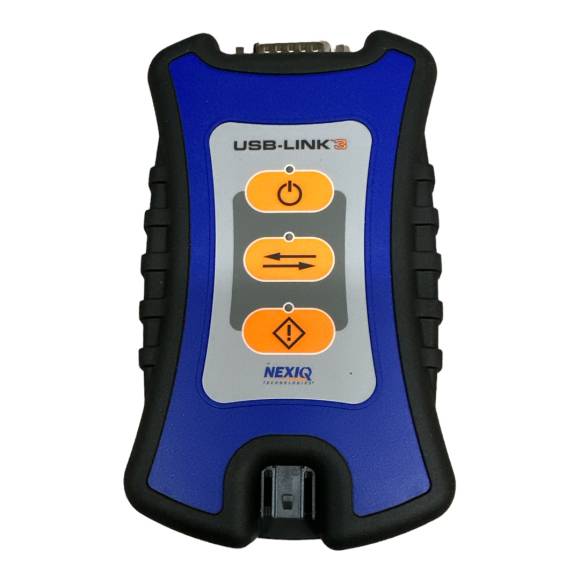
When a Class 8 truck is sitting in your bay with a check engine light burning, every minute of dropped connectivity between your diagnostic interface and the ECU costs labor hours, customer trust, and bay turnover. The NEXIQ 121054 USB Link 3 Wired Edition (NQ121054) eliminates the single biggest variable in modern diagnostics: the wireless signal.
The Hidden Cost of a Dropped Diagnostic Connection
A shop scanning a DD15, an ISX, or a DT12 transmission cannot afford a dropped Bluetooth pairing mid-flash. When wireless coverage fails — and in steel-walled bays, behind tractor cabs, or near welding equipment, it fails often — the technician restarts the session, re-establishes ECU handshakes, and sometimes loses the diagnostic state entirely. A 20-minute fault read becomes a 90-minute job. A 45-minute flash becomes a bricked controller. Multiply that across a fleet shop running six bays daily, and the cost of unreliable connectivity easily exceeds the price of a proper VCI within a single week of operation.
Five Reasons the NQ121054 Belongs on Every Diagnostic Cart
- Zero Wireless Dropouts: A USB 2.0 hardline keeps ECU sessions stable through long flashes, parameter writes, and live data streams — no Bluetooth pairing, no Wi-Fi channel collisions, no RF interference from welders or shop equipment.
- Full Modern Protocol Stack: CAN FD, DoIP, J1939 FD, and ISO 15765 FD support keeps the NQ121054 compatible with 2024 and beyond Class 8 architectures, including gateway-protected modules.
- Complete Legacy Coverage: J1708, J1850 VPW, Single-Wire CAN (SWCAN), Fault-Tolerant CAN (FTCAN), KWP2000, and ALDL keep older equipment serviceable on the same interface.
- OEM Software Compatibility: RP1210 a/b/c compliance and partial J2534 implementation let the VCI run Detroit Diesel Diagnostic Link, Cummins INSITE, PACCAR Davie4, Volvo PTT, Allison DOC, Bendix ACom Pro, and dozens more.
- Multi-Platform Ready: Direct USB connection to Windows 10/11 laptops, iOS, and Android devices means one VCI travels from the shop bay to the roadside service call without a configuration change.
Why the NQ121054 Solves the Wireless Problem by Design
The previous-generation USB Link 2 included Bluetooth and Wi-Fi by design — features that sound great in product marketing but introduce real shop-floor headaches. The NEXIQ 121054 USB Link 3 Wired Edition strips those features out deliberately. This unit is not Bluetooth or Wi-Fi compatible — and that is the point. Every byte travels through the included 15-foot latching USB cable directly to your PC, tablet, or smartphone. There is no pairing handshake, no channel negotiation, no firmware authentication delay, and no possibility of mid-session signal loss. You plug in, the software sees the interface, and you are talking to the ECU within seconds.
For a shop owner managing risk, this is not a downgrade — it is a deliberate engineering choice. The wireless feature set that markets well in a brochure is the same feature set that causes the most expensive single-event failures in modern diagnostics: corrupted ECU flashes and bricked controllers. The NQ121054 trades RF flexibility for guaranteed signal integrity, and for fleet shops that calculation is obvious.
Failure Modes That Wired Connectivity Physically Eliminates
Modern diagnostic sessions involve far more than reading fault codes. A typical workflow on a current Class 8 truck may include any of the following — often in a single visit:
- Live data streaming across hundreds of parameter IDs at 10 to 100 Hz refresh rates
- ECU flash programming that can run 20 to 90 minutes per module, with several modules per truck
- Parameter file uploads that must complete without interruption to avoid module bricking
- DPF forced regenerations requiring stable bidirectional communication for the entire cycle
- Multi-module routine activation for emissions diagnostics, brake calibrations, transmission relearns, and aftertreatment service procedures
Each of these procedures has a hard failure mode if the link drops mid-process. A Bluetooth pairing loss during a DEF dosing module flash can brick the controller, requiring a dealer reset or full module replacement. A Wi-Fi channel collision during a transmission TCM update can leave the truck undrivable until towed to a dealer. The NQ121054's wired-only architecture makes these failure modes physically impossible. The cable either is connected or it is not — there is no intermittent state, no signal degradation as the technician walks around the truck, and no interference from the welder running in the next bay.
Real-World Bay Scenarios Where Wireless Costs You Money
Consider four common shop environments where the NQ121054's wired architecture outperforms a wireless VCI on every metric that matters to the technician and the shop owner.
The crowded fleet terminal. Twelve trucks in for scheduled PM, four technicians, each running a wireless VCI on overlapping 2.4 GHz channels. Bluetooth collisions slow every diagnostic session, and intermittent dropouts trigger re-pairings that interrupt the technician's workflow. The wired NQ121054 sidesteps RF congestion entirely. Four units operating in the same shop interfere with each other zero percent of the time.
The mobile service call. A field technician rolling to a roadside breakdown cannot rely on shop Wi-Fi or stable Bluetooth on a vibrating chassis. USB through the cab window gives the tech a guaranteed connection while the engine runs and the alternator pulses electrical noise across the harness. No pairing delays, no signal hunting — the diagnostic session is online the moment the cable seats.
The body shop with welding nearby. Arc welding generates broadband RF interference that wreaks havoc on 2.4 GHz Bluetooth and Wi-Fi channels. Wired VCIs are immune to this entire class of interference. The body shop technician can read fault codes while the welder runs ten feet away.
The remote logging-road service truck. No cell signal, no shop Wi-Fi, just a laptop and a VCI. The NQ121054 needs neither — it talks to the PC over USB, and the PC talks to the ECU through the VCI. The diagnostic loop is fully self-contained and does not assume any external connectivity exists.
Protocol Coverage: A VCI Built for the Next Decade
The NQ121054 isn't just a wired version of an older tool — it carries a thoroughly modern protocol stack ready for the next decade of heavy-duty trucks. Documented support includes:
- CAN FD, J1939 FD, ISO 15765 FD at 250K, 500K, and 1M b/s with auto baud detection
- Diagnostics Over Internet Protocol (DoIP) — required for many 2023+ commercial vehicles with gateway architecture
- Single Wire CAN (SWCAN) per ISO 11898-3
- Fault Tolerant CAN (FTCAN)
- J1708, J1850 VPW (Class 2), ISO PWM (SCP), ISO 9141, KWP2000 (ISO 14230) for legacy coverage
- K/L line, ALDL 9600 and 8192 baud, ATEC 160 baud for vintage applications
- RP1210 a/b/c and J2534 (2004 draft) / J2534-1 partial implementation for OEM software compatibility
This combined coverage means a single VCI serves trucks from the early 1990s through the latest 2026 Class 8 chassis. Shops standardizing on the NQ121054 reduce VCI inventory, simplify technician training, and eliminate the "which adapter for which truck" question that slows down a diagnostic queue. One interface, one driver install, one familiar workflow — across the entire shop.
Fleet-Level ROI: What a Reliable VCI Actually Saves
The math on a diagnostic VCI becomes obvious when you account for downstream costs. A wireless VCI dropout during a routine fault scan typically costs the shop:
- 15 to 30 minutes of restart time per occurrence
- Potential ECU session corruption requiring vehicle power cycling
- Re-pairing time if Bluetooth credentials reset between sessions
- Customer frustration when a quoted "10-minute scan" becomes a 60-minute event
- Risk of mid-flash module corruption requiring dealer-level intervention
At a $140 per hour shop billing rate, a single weekly dropout per technician costs roughly $7,000 to $14,000 per technician per year in lost productivity and rework. Multiply by a six-bay shop, and the annual exposure easily passes $60,000. The NQ121054, at $740, pays for itself the first time it prevents a botched flash. Standardize a fleet shop on three wired VCIs instead of three wireless units, and the math works out within the first calendar quarter.
Why VCI Standardization Matters for Multi-Brand Fleets
Most heavy-duty shops service mixed fleets — Freightliner Cascadias with DD15s, Peterbilts with X15s, Kenworths with PACCAR MX-13s, Internationals with A26s, and Volvo VNLs with D13s. Each OEM software platform expects a compatible VCI on the other end of the cable. The NQ121054's RP1210 compliance means it appears as a standard interface to:
- Detroit Diesel Diagnostic Link (DDDL)
- Cummins INSITE and Cummins Guidanz
- PACCAR Davie4
- Volvo Premium Tech Tool (PTT)
- Mack ASIST
- Allison DOC
- Bendix ACom Pro
- Wabco Toolbox
- Eaton ServiceRanger
- Dozens of additional OEM and component-level platforms
That breadth means a single technician can scan, program, and calibrate across the entire shop with one VCI clipped to one laptop. No software-switching, no adapter swapping, no waiting for a colleague to free up "the Cummins interface." The bay flow accelerates because the diagnostic constraint disappears.
What Ships in the NQ121054 Carrying Case
The NQ121054 arrives in a rugged plastic carrying case containing every cable needed to begin diagnostic work on heavy-duty trucks:
- The USB Link 3 wired VCI body
- 493128 9-pin Deutsch cable (1 meter)
- 493113 long 16-pin OBDII / J1962 cable
- 15-foot latching USB cable
- Quick start reference guide
Because the USB Link 3 uses the same cable family as the previous USB Link 2, shops upgrading do not need to rebuild their adapter kit. Existing Caterpillar 9-pin adapters, Deutsch breakouts, and OEM-specific cables continue to work — protecting the cable investment most shops have already made.
Maintenance Schedule Context: Where the NQ121054 Earns Its Keep
For a fleet maintenance program, the VCI is touched daily — multiple times per truck, across PM intervals at 25K, 50K, 100K, and 200K miles. At each interval the diagnostic procedure includes a J1939 health scan, an aftertreatment review, brake module check, transmission ECU read, and increasingly a DPF status verification. The diagnostic interface is in active use for hours per truck across a PM cycle, and any single dropout cascades into rework. A wired VCI eliminates that variability completely, allowing the maintenance bay to run on a predictable time budget per truck.
Frequently Asked Questions
Q: Does the NQ121054 support Bluetooth or Wi-Fi?
A: No. The 121054 Wired Edition is intentionally USB-only. If wireless connectivity is required, NEXIQ offers a separate wireless USB Link 3 variant, but the wired NQ121054 trades RF flexibility for guaranteed signal stability.
Q: Will the USB Link 3 work with my existing USB Link 2 cables?
A: Yes. The USB Link 3 uses the same cable set as the USB Link 2, so existing 9-pin Deutsch, 16-pin OBDII, 6-pin, and OEM-specific cables remain compatible. Upgrading does not require rebuilding the adapter kit.
Q: Does the NQ121054 support DoIP for 2023 and newer trucks?
A: Yes. The USB Link 3 supports Diagnostics Over Internet Protocol (DoIP), which is increasingly required for modern emissions systems and gateway-protected modules on current Class 8 chassis.
Q: Can I run OEM software like DDDL or INSITE through this VCI?
A: Yes. The NQ121054 is RP1210 a/b/c compliant and includes a partial J2534 (2004 draft) and J2534-1 implementation focused on commercial vehicles. It works with the major OEM diagnostic platforms used across heavy-duty service.
Q: Will it work with my iPad or Android tablet?
A: Yes. The USB Link 3 connects via USB to Windows 10/11, iOS, and Android computing platforms. Tablet workflows depend on the specific diagnostic application supporting the device class.
Q: How long is the included USB cable?
A: The included latching USB cable is 15 feet, giving a technician enough length to reach from the cab to a laptop on the fender, shop cart, or service truck bench.
Q: Is the NQ121054 rugged enough for daily shop and field use?
A: Yes. The unit ships in a hard plastic carrying case and the VCI body is built for shop-floor abuse — dropped tools, fluid splash, and harsh vibration are part of the design target.
Q: Does Apex Tool Company offer free shipping?
A: Yes. Apex Tool Company offers free shipping on orders over $500 within the continental United States. The NQ121054 at $740 ships free.
Stop Losing Bay Time to Dropped Diagnostic Sessions
Order the NEXIQ 121054 USB Link 3 Wired Edition (NQ121054) — $740 — and run every diagnostic session on a guaranteed wired connection. In stock now at Apex Tool Company. Free shipping on orders over $500 within the continental US.
SHOP NQ121054 — $740 →Questions? Call 812-579-5478 / 800-365-2233 — Mon–Fri 8 a.m.–5 p.m. ET
overall rating:
my rating:
log in to rate