

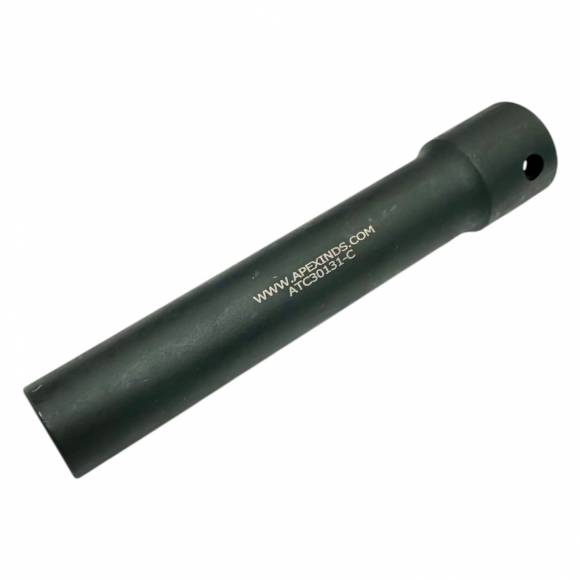
A single rounded rocker stud on a Series 60 can pull a head, kill a torque sequence, and turn a 90-minute valve job into a three-day teardown. The ATC30131-C exists to keep that from happening.
The Real Cost of Reaching for the Wrong Socket
Detroit Diesel Series 60 rocker arm fasteners sit deep, recessed, and surrounded by valvetrain geometry that doesn't forgive improvisation. Standard 12-point sockets are too shallow to fully seat. Deep sockets without a stepped OD collide with rocker pedestals. The result is partial engagement, rounded flats, and torque values that mean nothing because the wrench was already slipping at 60% load. A $58 socket prevents a head pull. The math isn't subtle.
- Deep recessed access — the 12mm 12-point extra-deep profile reaches fasteners that standard sockets physically cannot bottom out on, giving you full flat-to-flat engagement every time.
- Stepped outer diameter for clearance — the tool slips past rocker arms, springs, and pedestals without contact, eliminating the lever-prying technicians resort to with the wrong tool.
- True torque transfer — 12-point engagement applies torque uniformly across all six contact faces, the only way a calibrated torque wrench reading actually means what it says.
- OEM J-44706 equivalent — built to the same dimensional spec Detroit Diesel calls out for shaft service, replacing the older, shorter J-36003-A that left technicians stranded on tight installs.
- 1/2-inch drive compatibility — works with every common torque wrench, breaker bar, and air impact in a heavy-duty shop, no adapters or step-down stack-ups required.
Why $58 Buys More Than a Socket
The ATC30131-C Rocker Stud Socket is one of those tools that doesn't look like much until you've watched a tech ruin a $1,400 cylinder head trying to get by without one. Series 60 rocker shafts are torqued to manufacturer-specific values for a reason — the shaft sits on pedestals that align the rocker geometry to the valve stems. Under-torque and the shaft walks under load. Over-torque and you distort the pedestal or stretch the studs into plastic deformation. Both end in valve train failure. The ATC30131-C is the only socket profile in most heavy-duty kits that lets you hit those torque specs accurately, with full engagement, in the cramped envelope a Series 60 rocker box gives you. At $58.00 with a 1.00 lb ship weight, it's the cheapest insurance policy you'll buy this quarter.
Failure Modes the Wrong Socket Creates
Most Series 60 valvetrain comebacks trace to one of four failure modes, and three of them start at the fastener. Understanding what goes wrong without the right socket helps explain why this specific tool earns its place on the bench.
Rounded fastener flats. A 6-point socket without enough depth contacts only the chamfer at the top of the fastener. When you load it, the corners of the hex deform first. By the time you notice the wrench is slipping, you've already taken 0.3–0.5 mm off each flat. That fastener is now a removal-only item, and removal usually means cutting it off — which on a recessed rocker stud means a magnetic chip retrieval session in the gallery.
Under-torqued shafts. When the socket doesn't fully seat, the torque wrench clicks early. Technicians log the value and move on. Three hundred hours later, the rocker shaft has migrated, valve lash is out of spec on every cylinder, and the engine is making a top-end tick the operator brought in as "a noise." The repair order is now valve adjustment plus head inspection plus shaft replacement.
Cocked fasteners. A socket that doesn't sit square against the fastener pulls the bolt sideways during torque application. The stud bottoms into the head at an angle, the pedestal sits unevenly, and the rocker geometry shifts the valve stem contact point. You will see this as accelerated valve guide wear and an engine that drinks oil at 200,000 miles instead of 800,000.
Collateral component damage. Standard deep sockets without a stepped OD will gouge rocker arms, scuff bridge inserts, and chip the soft anodized coating on aluminum pedestals. None of that shows up on a labor estimate until the engine comes back with a flagged warranty claim. The customer doesn't pay for the second visit. The shop does. And in the meantime, three other Series 60 jobs in the bay are getting the same socket treatment from the same tech who hasn't been told the failure rate yet.
Cross-threading from cocked starts. When the socket sits at an angle on the fastener head, the wrench rotates the entire assembly at the same angle. Starting a stud or nut under that condition cross-threads the engagement in the head — and on Series 60 castings, cross-threaded rocker stud bores are an expensive repair involving either heli-coil installation or, in the worst case, head replacement. The ATC30131-C's full-engagement profile holds the fastener square to the bore from the first rotation onward.
Hidden stress concentrations. Even when a damaged fastener appears to torque correctly on a comeback inspection, the metallurgical damage from a previous mis-engagement persists. Micro-cracks at flat corners or witness marks from slipped sockets create stress risers that propagate over thermal cycles. The fastener that survived assembly may not survive 100,000 miles of duty cycle, and the failure will trace back to the original service event — long after the labor ticket has been closed and the warranty window has expired.
Real Shop Scenarios Where This Tool Pays for Itself
Scenario one: in-frame top-end refresh. A fleet brings in a Series 60 at 750,000 miles for an in-frame valve job. The tech pulls the valve cover, removes the rocker shaft, performs the valve work, and goes to reinstall. Without the ATC30131-C, the closest tool is a generic 12mm deep socket borrowed from the brake bay. Torque values are inconsistent across the eight rocker shaft fasteners. Two weeks later the truck is back with a ticking lifter complaint. Now the tech is pulling that same valve cover again on labor that won't bill — because the diagnosis points back to the original repair. The ATC30131-C closes that loop on the first attempt.
Scenario two: complete engine rebuild. Mid-life rebuild on a Series 60 pulled from a refuse truck. The engine is on a stand, head off, full visibility. The rebuilder torques the rocker shafts using the right socket, hits spec the first time on every fastener, and the valve lash sets clean. The engine goes back in, runs to 1.2 million miles before the next major service. That's what a $58 socket buys when the procedure runs clean from the start.
Scenario three: warranty diagnosis. A repower shop receives a Series 60 reman engine with documented low oil pressure complaints under load. Inspection reveals one rocker shaft fastener torqued to 65% of spec, with visible witness marks showing the socket had not fully seated during assembly. The unit goes back to the rebuilder. The cause is traced to a deep socket without the stepped OD profile. Every shop with the ATC30131-C in its top drawer has eliminated that failure mode permanently.
When the ATC30131-C Comes Out of the Drawer
This socket isn't a daily-driver. It's a specialty tool that earns its keep during specific service intervals on Series 60 engines. Knowing when to reach for it keeps the rest of your tooling out of the failure path.
Scheduled valve adjustment. Detroit Diesel calls for valve lash inspection and adjustment at OEM intervals — typically every 250,000 to 500,000 miles depending on duty cycle. Rocker shaft fasteners come loose for inspection during this service, and torque-to-spec is mandatory on reinstall.
Top-end service after high-mileage events. Any time a head comes off — gasket failure, EGR delete, hard-part inspection — the rocker shaft must come out and go back on with verified torque. This socket lives on that bench.
Engine rebuild and reassembly. Full rebuilds run through every valvetrain fastener at least once. Rebuilders who track first-time-right percentages know which sockets show up in their failure-mode reports — and which ones don't.
Pre-delivery torque verification. Reman shops verifying torque values before crating an engine for shipment use the ATC30131-C to spot-check rocker shaft fasteners. A 60-second verification catches assembly errors that would otherwise return as warranty failures.
Fleet-Level ROI: Why Twenty Shops Already Did This Math
The argument for buying the ATC30131-C dies the moment you compare its cost to a single comeback. A typical Series 60 valve train comeback bills out at 4–6 hours of diagnostic time, 6–10 hours of labor, plus parts. Even at conservative shop rates, that's $1,500 to $2,500 of unbillable work the second a customer brings the truck back complaining about a noise that wasn't there before service. Add the soft cost of a damaged customer relationship, a flagged warranty claim, or a fleet account that quietly migrates business to a competitor, and the real number runs higher than any spreadsheet will show.
Run the multiplier across a five-bay shop performing Series 60 work weekly. If a single comeback per quarter traces back to inadequate rocker shaft torque, the annual cost is somewhere between $6,000 and $10,000 in unrecovered labor. A $58 socket purchased one time eliminates that failure category permanently. The ROI is so lopsided that most shop owners don't model it — they just buy the tool the first time a tech describes the alternative.
For owner-operators rebuilding their own engines, the math is even more direct. A single ruined cylinder head from a misapplied torque sequence costs more than every specialty Series 60 tool in the Apex catalog combined. Buying the right socket up front is the cheapest line item on a rebuild parts list. The same logic applies to repower shops, marine diesel facilities, and stationary power applications running Series 60 platforms — wherever the engine lives, the rocker shaft torque procedure is the same, and the failure cost is the same.
What Separates the ATC30131-C from a Generic Deep Socket
Walk into any heavy-duty parts house and you can buy a 12mm 12-point deep socket for under twenty dollars. So why does the ATC30131-C exist as a specialty SKU at all? The answer lives in three specific design choices that distinguish a tool engineered for an application from a tool that approximately fits.
Engagement depth. Standard "deep" sockets in the generic market run somewhere between 50mm and 70mm in overall length. Series 60 rocker studs sit at a depth that demands the extra-deep profile specifically called out in the OEM specification. Generic deep sockets bottom out on the casting before the flats reach the fastener. The ATC30131-C's extra-deep profile is dimensioned to clear the recess and seat fully — the difference between fully seated and almost-seated is the difference between a torque value you can trust and a torque value that means nothing.
Outer diameter geometry. A typical 12-point socket has a uniform OD from drive end to fastener end. That works fine in open space. It doesn't work in a Series 60 rocker box, where the socket has to thread between rocker arms and pedestal hardware to reach the fastener. The stepped OD on the ATC30131-C narrows the body in the engagement zone, giving you clearance where the surrounding components live and full wall thickness where the torque load is applied. That step isn't decorative — it's the difference between getting the tool to the fastener and not.
Service heritage. The ATC30131-C is the OEM J-44706 equivalent, which itself superseded J-36003-A and J30131-B. That progression tells a story: Detroit Diesel's engineering organization revised the spec because earlier tools weren't doing the job. Buying the current OEM-equivalent profile means you're using the spec the service procedure was rewritten around. Generic tooling sits outside that revision history.
Ordering, Shipping, and What to Expect
The ATC30131-C ships from Apex Tool Company's inventory at $58.00, with a 1.00 lb shipping weight. Stock status is current at time of writing — in stock, ready to ship from the warehouse. US continental orders over $500 ship free, so combining this socket with other Series 60 tooling, DD-platform specialty tools, or shop consumables on the same order is the natural path if you're equipping or restocking a bay.
For order questions, current lead time confirmation, or fleet/shop account inquiries, the Apex sales team is reachable at 812-579-5478 or 800-365-2233 Monday through Friday from 8 a.m. to 5 p.m. ET. That phone number reaches people who know the catalog — not a call center reading from a script. If you need to verify which Apex SKU corresponds to a specific OEM service tool number on your manual, that's the right number to call.
Frequently Asked Questions
Q: Is the ATC30131-C the same as the older J-36003-A?
No. The J-36003-A was the original shorter socket Detroit Diesel specified, and it was superseded by J-44706 because the original tool didn't have enough depth for certain configurations. The ATC30131-C is the J-44706 equivalent — the current OEM-spec replacement.
Q: Will this socket work on engines other than the Series 60?
The tool is dimensionally designed for the Series 60 rocker shaft fastener and the clearance envelope around it. It may fit other 12mm 12-point applications, but the stepped OD profile is specifically optimized for Series 60 valvetrain geometry. For other engine platforms, check the Apex catalog for the application-specific equivalent.
Q: Is the 1/2-inch drive compatible with impact wrenches?
Yes. The socket is heavy-duty construction rated for use with impact tools, though final torque-to-spec should always be performed with a calibrated torque wrench rather than an impact gun.
Q: What's the difference between the ATC30131-B and the ATC30131-C designations?
These are sequential Apex part number iterations of the same OEM-equivalent J-44706 tool. The current production version is what ships from the warehouse — both designations route to the same SKU on the product page.
Q: Can I use a 12-point chrome socket from my general kit?
Mechanically you can put it on the fastener. The problems are depth and clearance. Standard chrome 12-points without the extra-deep profile won't fully engage the recessed stud, and without the stepped OD they'll contact surrounding valvetrain components when you rotate the wrench. The ATC30131-C exists because those failures kept happening.
Q: How is the tool heat-treated?
Heavy-duty professional construction, designed for repeated torque cycles under shop conditions. The socket holds tolerances through high-cycle use on torque-wrench applications.
Q: Is this tool covered by warranty?
Apex Tool Company stands behind every specialty tool in the catalog. Contact 812-579-5478 or 800-365-2233 Monday through Friday 8 a.m. to 5 p.m. ET for warranty questions.
Q: Does this qualify for free shipping?
Free shipping applies to US continental orders over $500. At $58.00, this tool alone is below the threshold, but combined with other Detroit Diesel tooling on the same order it can push you over.
Stop Risking Valve Train Failures on Series 60 Service
The ATC30131-C Rocker Stud Socket — $58.00, in stock, ships from Apex.
Order the ATC30131-C — $58.00📞 812-579-5478 / 800-365-2233 · Mon–Fri 8 a.m.–5 p.m. ET · Free shipping over $500