
Blog
Why the ATCCATS0260 is Critical for Metric Dowel Pin Removal
Why a $180 Slide-Hammer Kit is the Insurance Policy Every Diesel Shop Needs
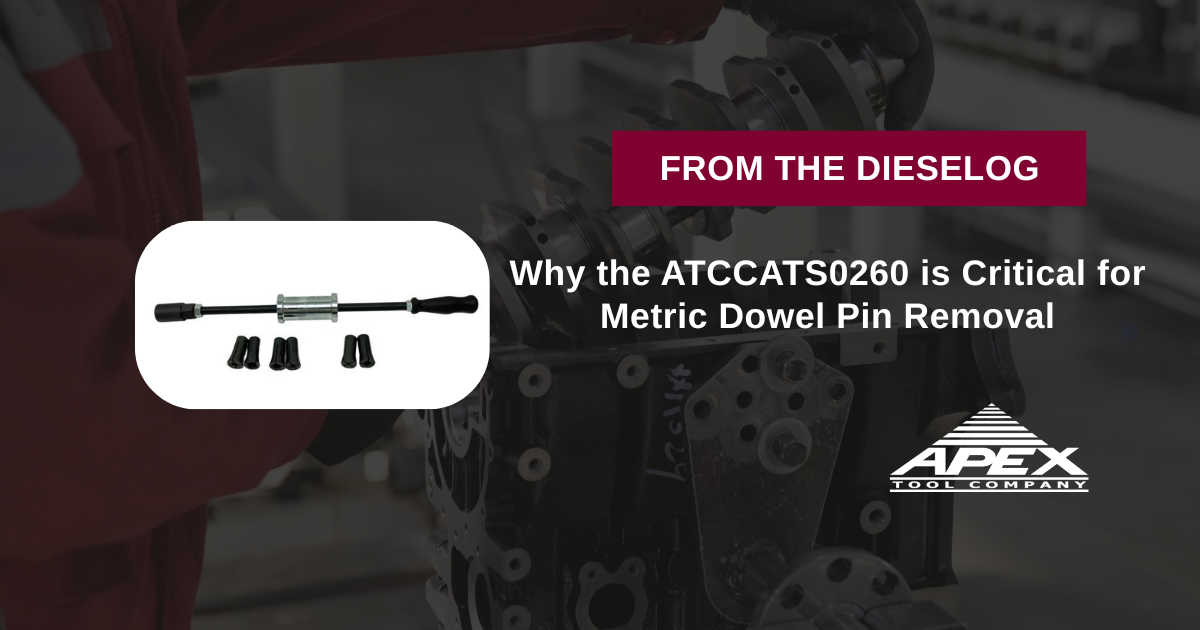
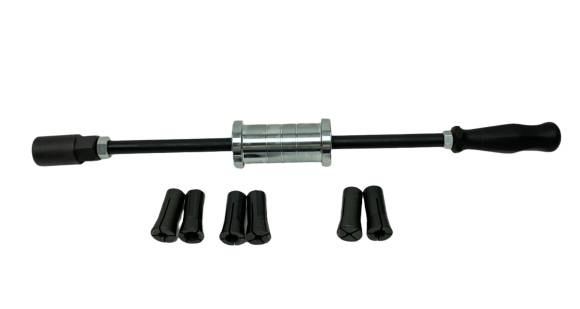
One slipped punch, one cracked dowel hole, and a cylinder head becomes a paperweight. The ATCCATS0260 Metric Dowel Pin Puller Kit is the difference between a clean rebuild and a write-off.
The Hidden Cost of a Stuck Dowel Pin
Every diesel technician knows the moment. The head is off, the gasket is peeled back, and there it is — a metric dowel pin, seized in the deck, coated in a fine ring of corrosion and locked tight. The temptation is to grab vise grips, a pin punch, or worse, a MIG welder with a slide hammer welded to the pin. Every one of those shortcuts has put expensive blocks and heads in the scrap bin. A bent pin gouges the bore. A welded-on slide hammer overheats the parent metal. A side-loaded pull cracks the casting around the pin hole and there is no fixing that.
The ATCCATS0260 was engineered specifically to eliminate that risk on metric-pinned engines and machinery, with a controlled, axial pull that protects the surface and the casting.
- ✅ Casting Protection: Pull force is applied perfectly perpendicular to the deck — no side load, no leverage on the parent metal, no cracked pin bosses.
- ✅ Six-Size Coverage: 6 mm, 8 mm, 10 mm, 12 mm, 14 mm, and 16 mm collets handle virtually every metric dowel pin you'll encounter on European, Asian, and modern domestic diesel platforms.
- ✅ Reusable Hardened Collets: The collets are built to outlast cheap, single-use extractors that strip on the second pull.
- ✅ Damage-Free Release: Unscrew the collet head or tap the hollow surface to release the pin cleanly — no grinding, no torch, no cleanup.
- ✅ Shop-Ready Kit Format: Organized storage means the right collet is always findable in 10 seconds — not 10 minutes of digging in a tool chest.
$180 of Insurance Against a $4,000 Mistake
Here's the math nobody wants to do until it's too late. A modern cylinder head for a Cummins ISB, a Detroit DD15, or a Volvo D13 ranges from $3,200 to $6,500 reman'd. An engine block? Easily $8,000 to $15,000 if you can even source one. Now look at the dowel pin holes on the deck surface. Crack the pin boss while levering on a stuck pin and that head becomes scrap — not a core charge, scrap. The ATCCATS0260 Metric Dowel Pin Puller Kit costs $180. That's not a tool purchase. That's an insurance premium on every metric block and head that comes through your shop.
And it's a one-time spend. The puller body is hardened. The collets are reusable. The kit comes back to the bench for the next job, the next month, the next year. Compared to the cost of even a single ruined casting, the payback period is one job — sometimes one pin.
Why Metric Dowel Pins Seize in the First Place
Dowel pins live in a brutal environment. They sit at the head-to-block interface, exposed to combustion pressure pulses, thermal cycling from cold start to 220°F coolant temp, and the slow, steady corrosion of coolant chemistry interacting with dissimilar metals. Over 200,000 miles, or 8,000 engine hours on a stationary unit, a press-fit pin can effectively become one piece with the casting. The interference fit, originally a few thousandths, becomes a galvanic weld.
There are four common failure modes that lock a dowel pin in place: galvanic corrosion between the steel pin and the cast iron or aluminum bore, coolant chemistry deposits forming a hard scale at the joint, thermal expansion mismatch on aluminum heads that effectively wedges the pin tighter every heat cycle, and simple oxidation when an engine sits with coolant leaks for months. Any one of these will defeat a hammer-and-punch approach. All four together — common on a high-mileage truck or marine engine — require the controlled pull that only a proper slide hammer collet system delivers.
The ATCCATS0260 addresses all four failure modes the same way: it grips the pin internally with a collet, transfers shock load purely along the pin's axis, and breaks the corrosion bond without applying any side load to the casting. The shock wave does the work. The casting stays untouched.
Comparing the ATCCATS0260 to Improvised Alternatives
Every shop has its own folklore around dowel pin extraction. Some of these methods work occasionally. Most of them risk the parent metal. Here's the honest, technician-level comparison between common alternatives and the procedure-correct approach with a slide-hammer collet kit.
Vise grips and a brass hammer. Probably the most common improvised method. The vise grips clamp the exposed pin head, the technician pulls and twists, and the pin sometimes comes free. The problem is that vise grip jaws are serrated — they chew up the pin surface, and any subsequent pull develops less and less grip as the metal galls. Worse, the typical pull motion includes a lateral component that side-loads the casting. On aluminum heads, that lateral force is exactly what cracks pin bosses. Verdict: works on truly easy pins, dangerous on anything corroded.
Welded nut and slide hammer. A nut is MIG-welded to the top of the dowel pin, a separate slide hammer is threaded onto the nut, and the technician pulls. This technique actually does deliver axial load — that part is correct. The problem is the heat. Welding to a dowel pin puts a heat-affected zone directly into the parent casting metal. On aluminum heads, the localized heat distortion is enough to warp the deck surface. On cast iron, the HAZ creates a brittle ring around the pin that can crack on the next gasket torque-down. Verdict: works mechanically but introduces metallurgical risk that often doesn't show up until 5,000 miles later, when the head fails.
Drilling out the pin. If extraction has failed entirely, some shops drill the pin out using progressively larger bits, then re-bush the bore. This is salvage work — it's the right call when nothing else has worked, but it adds 2–4 hours of careful machining time and the bushed bore is never quite the same as the original. Verdict: a last resort, not a method.
Generic shop slide hammer with a hook attachment. Many shops have a general-purpose slide hammer with hook and screw attachments for body panel work or seal removal. These can sometimes be improvised to pull dowel pins, but the attachments don't grip the pin's full circumference — the grip is partial, and the load path isn't perfectly axial. The slip rate is high, and a slipping slide hammer is the single most common cause of damaged casting surfaces in the shop. Verdict: not engineered for the job, and the slip risk alone justifies the dedicated tool.
The ATCCATS0260 dedicated kit. Collet-locked, axial-only shock load, six sizes matched to standard metric thread pitches, reusable hardened components. No heat. No side load. No improvisation. The same procedure works on every metric pin in the 6–16 mm range, every time. Verdict: the only method engineered specifically for this job.
Real-World Scenarios Where This Tool Pays for Itself
Scenario 1 — Aluminum Head, Cracked Pin Boss. A truck shop technician working on a Mercedes OM906 medium-duty diesel grabs a punch and a brass hammer to drive out a stuck 10 mm dowel pin from below. The pin shifts but doesn't release. He levers it sideways with a pry bar. The aluminum boss cracks. Head condemned. Loss: $3,800 plus 6 hours of labor. The ATCCATS0260, used the first time, would have pulled that pin in 90 seconds.
Scenario 2 — Marine Diesel Reman. A reman shop processes a Volvo Penta D6. Two of the four block-deck dowels are seized — common on saltwater-cooled engines. With a slide hammer collet kit, both pins come out in under five minutes. Without it, the operator typically welds a nut to the pin, then a slide hammer to the nut. Heat-affected zone in the deck. Reject for warpage. Loss: roughly $4,200 in block value, plus a customer claim on the rebuild.
Scenario 3 — Fleet Rebuild Bay. A municipal transit fleet pulls four DD13 heads in a single week for valve work. Two have seized dowel pins — typical for high-coolant-cycle service. The shop owns one ATCCATS0260. Total dowel removal time across both heads: under 10 minutes. Without the tool, the average shop loses 45 minutes per stuck pin to manual extraction attempts. Across a year of fleet work, that recovered time alone pays for the kit several times over.
Maintenance Schedule Context: When Dowel Pin Work Shows Up
Dowel pin extraction isn't a stand-alone job. It happens during specific service events, and shops that handle these events regularly need this tool in the standard kit. Major in-frame and out-of-frame overhauls always involve dowel pin work — the head comes off, the dowels stay with the block, and any seized pin has to come out before the new head and gasket go down. Cylinder head replacement, whether for cracked castings, valve seat work, or warpage, requires clean dowel pins for accurate alignment of the new head. Block deck resurfacing demands pin removal before machining. Flywheel and flexplate service on engines with dowel-located flywheels requires the same controlled extraction.
On a typical heavy-duty diesel shop schedule, that's anywhere from one to four dowel pin extraction jobs per week. Multiply that by the time savings per pin, and the ATCCATS0260 stops looking like a $180 tool and starts looking like a critical line item in the shop's labor recovery.
Fleet-Level ROI: The Real Numbers
Consider a 25-truck fleet running heavy-duty diesel power. Average overhaul interval is 750,000 miles. Across a 10-year fleet plan, that's roughly 33 major service events with head removal — and at a conservative 30% rate of seized dowel pins, you're looking at 10 dowel extraction situations over the fleet's life. At 45 minutes of recovered labor per pin (vs. manual methods), at $135/hour shop rate, that's $1,012 in labor recovery alone. Add even one prevented casting failure — say, a single ruined cylinder head — and the kit pays for itself 20 times over.
For a busy independent shop, the ROI math is even faster. Three to four dowel extractions per month, multiplied by recovered labor and prevented damage, makes the ATCCATS0260 one of the highest-return tool purchases in the entire diesel toolbox.
How to Audit Your Shop's Current Dowel Pin Process
Before you order anything, take 10 minutes to evaluate where your shop currently stands on dowel pin work. The answers will tell you whether this kit is a "nice to have" or a "stop-the-line, order it today" purchase.
First question: how many head jobs and major engine overhauls did your shop touch last quarter? Multiply by 0.3 — that's a conservative estimate of how many jobs involved at least one stuck dowel pin. Second question: how is your shop currently handling those stuck pins? If the answer involves vise grips, MIG welders, or anything described with the word "we usually figure it out," you have a procedure gap. Third question: in the last 12 months, has any casting in your shop been condemned or required machining repair because of dowel pin damage? If yes, the kit has already paid for itself retroactively the moment you buy it. Fourth question: what's your shop's labor recovery rate on dowel pin work? If you're billing 30 minutes for what's actually taking 60–90 minutes of tech time, you're losing money on every job — and the kit closes that gap directly.
Shops that run this audit honestly almost always discover that they've been quietly absorbing a recurring loss — measured in scrap castings, lost labor time, and occasional customer comebacks. The ATCCATS0260 doesn't just prevent the next loss; it converts a chronic procedural weakness into a documented, repeatable, billable standard.
What Comes in the Kit
The ATCCATS0260 ships as a complete extraction system. The hardened slide-hammer puller body provides the controlled shock load. Six interchangeable collets cover the standard metric range: 6 mm, 8 mm, 10 mm, 12 mm, 14 mm, and 16 mm — the diameters you'll find on virtually every European, Asian, and modern North American diesel platform. The collets thread onto the puller shaft and lock the pin internally for axial pull. Replacement collets and a replacement puller body are individually available, so the kit is repairable for the life of the shop.
Shipping weight is 8 pounds and the kit is currently in stock at Apex Tool Company in Columbus, Indiana, with same-day shipping available on orders placed before the daily cutoff. Free shipping applies to orders over $500 within the continental United States, so most shops can roll this kit in with their next parts and consumables order and absorb the entire cost into routine inventory replenishment — no special-order paperwork, no expedited freight surcharges, no procurement friction. Place the order today, have it on the tool board by the end of the week, and standardize your dowel pin procedure on the next head job that rolls into the shop.
Frequently Asked Questions
Q: Will the ATCCATS0260 pull dowel pins from aluminum cylinder heads without damaging the boss?
Yes — that's exactly what it's designed for. Because the pull force is applied straight along the pin's axis with no side load, the aluminum boss isn't stressed laterally. This is the failure mode that ruins most aluminum heads during manual extraction attempts.
Q: What thread pitches do the collets use?
The collets match the standard metric dowel pin thread pitches: M6×1.0, M8×1.25, M10×1.25, M12×1.25, M14×1.5, and M16×1.5. These cover the OEM specifications for virtually all modern metric engine dowels.
Q: Can I use this for non-engine applications — gearbox housings, transfer cases, hydraulic blocks?
Absolutely. Any metric dowel pin in that 6–16 mm range, in any precision-machined assembly, is fair game. Transmissions, transfer cases, hydraulic manifolds, marine outdrives, and industrial gearcases all use the same kind of press-fit metric dowels.
Q: How does the collet grip the pin?
The collet expands inside the pin's hollow center (or grips the pin's outer surface depending on configuration). Downward motion locks the collet. Slide-hammer action then transmits pure axial shock load to break the corrosion bond and free the pin.
Q: Are the collets reusable or single-use?
Fully reusable. The collets are hardened and rated for frequent professional shop use. To release a pulled pin from the collet, unscrew the collet head or tap the hollow surface.
Q: What's the shipping weight and how fast does it ship?
The kit ships at 8 pounds and is currently in stock. Free shipping applies to orders over $500 in the continental U.S.
Q: What if I lose or wear out one collet?
Individual replacement collets are stocked at Apex Tool Company in all six sizes (ATCCATS0260-A01 through -A13), and a replacement puller body is also available. You'll never need to buy the whole kit again.
Q: Will this tool work on dowel pins that are partially sheared off below the deck surface?
If enough pin material is exposed for the collet to grip — typically a few millimeters — yes. For fully sheared pins below the surface, you'll need a complementary broken-stud extraction method first.
Protect Your Next Rebuild for $180.00
The ATCCATS0260 Metric Dowel Pin Puller Kit — In Stock — Ships Today
SHOP THE ATCCATS0260 — $180.00 →📞 812-579-5478 / 800-365-2233 | Mon–Fri 8 a.m.–5 p.m. ET | Free shipping on orders over $500
overall rating:
my rating:
log in to rate