
Blog
Commercial Truck Driveline Yoke Removal Steps
Precision driveline component extraction guidelines for commercial truck maintenance fleets.
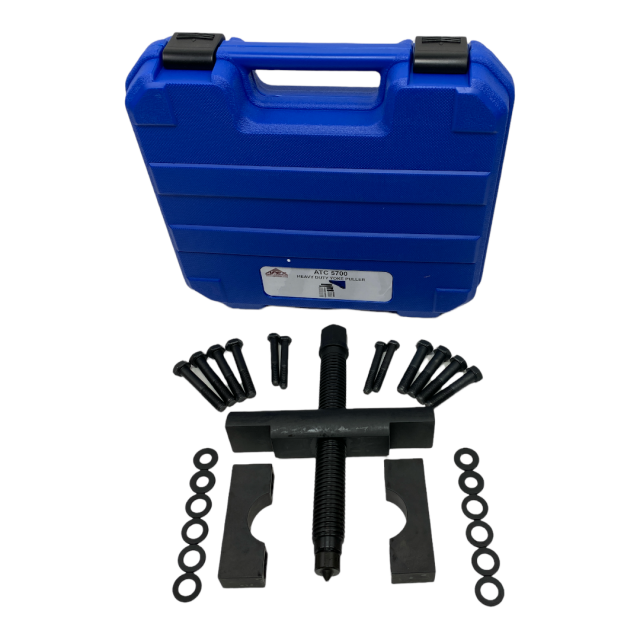
Prepping a Class 8 Freightliner, Kenworth, or Peterbilt for a pinion seal swap or differential overhaul? Follow this step-by-step professional workshop procedure to extract seized yokes safely without damaging splines or pinion bearings using the ATC 5700 yoke puller.
Why Hammering Yokes Brinells Pinion Bearings & Ruin Seals
Differential pinion shafts and transmission output shafts are supported by precision-ground tapered roller bearings. When a technician attempts to free a rusted drive yoke by striking the cast ears with heavy brass drifts or sledgehammers, every impact strike transfers thousands of pounds of shock load directly into the bearing rollers and races. This severe impact causes micro-indentations on the bearing tracks—a condition known as brinelling. Once a roller bearing is brinelled, it begins to whine, generate extreme heat, and fail prematurely under highway loads, leading to total differential lockup. Furthermore, off-angle hammering distorts the yoke hub, gouges fine shaft splines, and tears the pinion oil seal lip. Utilizing a heavy-wall puller fixture like the 14-pound ATC 5700 applies smooth, balanced axial tension directly along the centerline of the shaft, pulling the yoke off cleanly with zero shock impact to internal drivetrain components.
The 5-Step Driveline Yoke Extraction Protocol
- Driveline Teardown & Fastener Removal: Secure the vehicle wheels with chock blocks and release air pressure. Disconnect the driveshaft universal joint from the target yoke. Remove the pinion nut or output shaft retaining bolt using a heavy-duty impact socket, and clear away rust scale and road grime from the yoke hub.
- Position the ATC 5700 Puller Legs: Slip the dual pulling arms of the ATC 5700 puller over the outer bearing cap ears of the yoke hub. Verify that the puller feet seat fully and securely behind the bearing cap shoulders (compatible with 1-7/8″ to 2-3/16″ bearing diameters).
- Align the Central Forcing Screw: Position the heavy steel bridge plate squarely across the yoke face. Thread the central forcing screw down until its hardened anvil tip aligns dead-center against the center dimple of the pinion or output shaft snout.
- Execute Impact-Driven Extraction: Apply high-pressure molybdenum lubricant or anti-seize compound to the threads of the central forcing screw. Attach a 1″ air or electric impact wrench to the forcing screw drive hex and operate the impact wrench in smooth bursts. The ATC 5700 will generate over 25,000 lbs of linear pulling force, sliding the frozen yoke straight off the shaft splines.
- Inspect Shaft Splines & Proceed to Seal Service: Carefully lift away the extracted yoke and puller assembly. Inspect the shaft splines for wear or rust pitting, clean the splines thoroughly with a wire brush and solvent, and proceed with replacing the pinion oil seal or servicing the differential before re-torquing the yoke nut to OEM specification.
PRO-TECH FORCING SCREW LUBRICATION MANDATE:
Always coat the threads and tip of the ATC 5700 central forcing screw with extreme-pressure grease or anti-seize before every heavy extraction pass! Running dry threads under 25,000+ lbs of impact force causes severe thread galling and premature tool wear. Clean and lube screw threads regularly to maintain maximum pulling efficiency and tool life.
14 lbs of Solid High-Tensile Alloy Steel. Zero Driveline Brinelling.
Get the ATC 5700 Yoke Puller Now
overall rating:
my rating:
log in to rate