
Blog
Tech Guide: Correct Torque Adapter Calculations & Angle Alignment
Master extended lever-arm math and alignment angles for professional mechanical service.
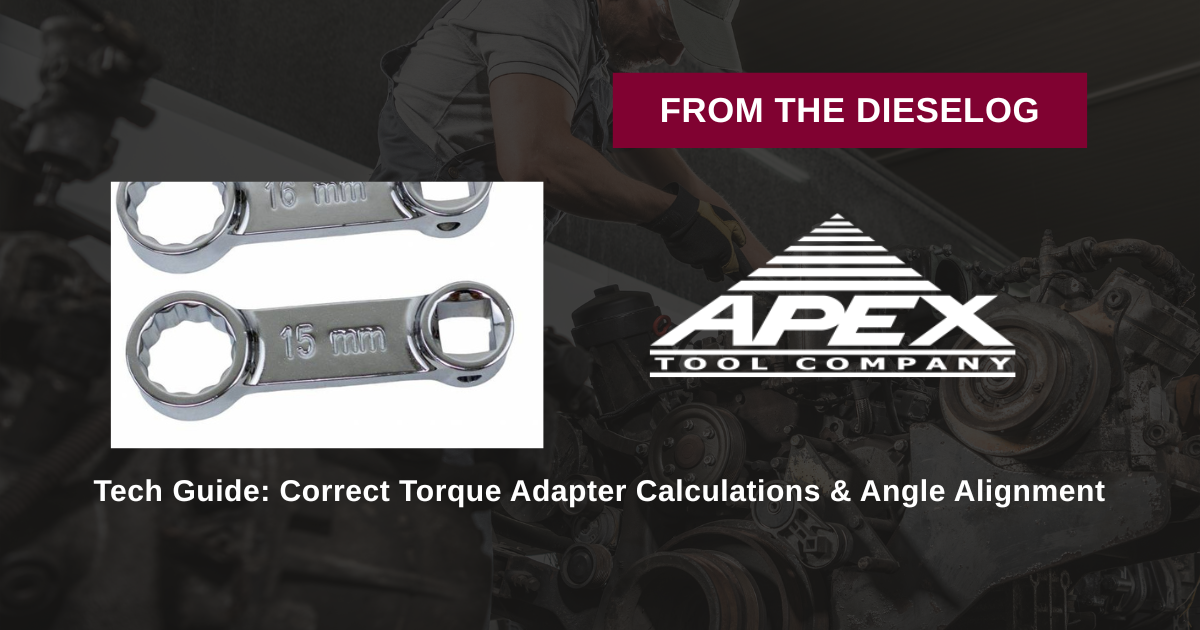
Servicing hard-to-reach metric fasteners on engine manifolds, suspension components, or hydraulic lines? Follow this step-by-step professional guide to position the ATC CAA0270 torque adapters, apply alignment formulas, and achieve 100% accurate fastener clamping force every time.
Why Incorrect Adapter Angles Cause Destructive Torque Errors
Torque adapters are problem-solvers when standard sockets cannot clear surrounding engine hardware. However, adding an adapter changes the physical geometry of the torque wrench. If a technician attaches a 2-inch adapter straight out ($0^\circ$ in-line extension) and sets the torque wrench to the target specification without calculating the extended lever arm, the actual torque applied to the fastener will be significantly higher than desired. Over-torquing stretches fasteners past their elastic limit, resulting in snapped bolt shanks or stripped aluminum threads. Conversely, if the adapter is angled backward ($180^\circ$), the applied torque drops dramatically, causing under-tightened bolts that loosen under engine vibration. To avoid complex math on the shop floor, technicians can orient the torque adapter at a right angle ($90^\circ$) to the wrench shaft. At $90^\circ$, the effective offset distance ($E$) relative to the torque axis equals zero, meaning $T_w = T_f$. The torque reading set on the wrench dial matches the torque applied to the bolt. When space constraints require an in-line orientation, applying the lever-arm offset formula guarantees correct torque application every time.
The 5-Step Torque Adapter Application Protocol
- Select Size & Inspect Fastener: Choose the correct adapter size from the ATC CAA0270 set (10mm to 19mm). Clean the fastener head and mating threads to ensure smooth torque engagement without thread binding.
- Determine Attachment Angle ($90^\circ$ vs $0^\circ$ In-Line): Assess clearance around the fastener. Whenever possible, position the adapter at a $90^\circ$ right angle to the torque wrench handle to maintain direct $1:1$ torque reading accuracy without calculation.
- Calculate Setting for In-Line ($0^\circ$) Use: If forced to use the adapter straight out ($0^\circ$), measure the wrench length ($L$) from drive center to handle center and the adapter offset ($E$). Calculate required wrench setting using $T_w = (T_f \times L) / (L + E)$.
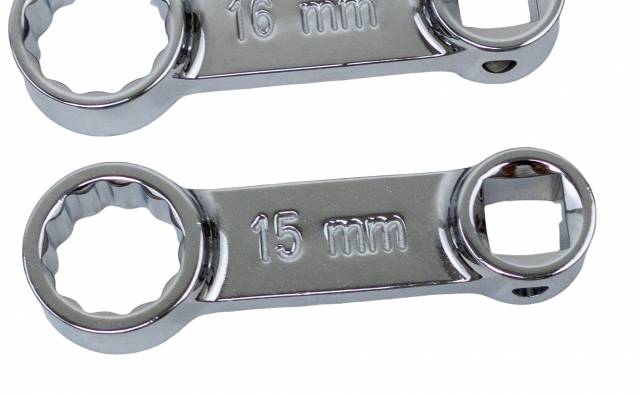
- Attach & Seat Adapter Securely: Insert the 3/8" square drive of the torque wrench into the female drive hole of the ATC CAA0270 adapter until the ball detent locks firmly into place. Slide the 12-point box end over the metric fastener head.
- Apply Smooth, Continuous Torque Force: Pull the torque wrench handle smoothly and perpendicular to the wrench shaft. Stop pulling immediately when the torque wrench clicks or reaches its target digital reading. Disengage the tool carefully to prevent side-loading the fastener.
PRO-TECH LEVER-ARM CALCULATION RULE:
Always maintain a $90^\circ$ angle between the torque adapter and wrench handle if you want to bypass mathematical conversions! Positioning adapters at arbitrary angles (like $30^\circ$ or $45^\circ$) changes the effective lever arm unpredictably, leading to improper torque application!
Precision Alloy Steel Adapters. Protect Torque-Critical Engine Repairs.
Get the ATC CAA0270 10-Piece Set Now
overall rating:
my rating:
log in to rate