
Blog
Why the ATC J-35906-A Is Critical for Every Detroit Diesel Series 60 Cam Gear Job
The master guide for precision cam gear installation on Series 60 engines.

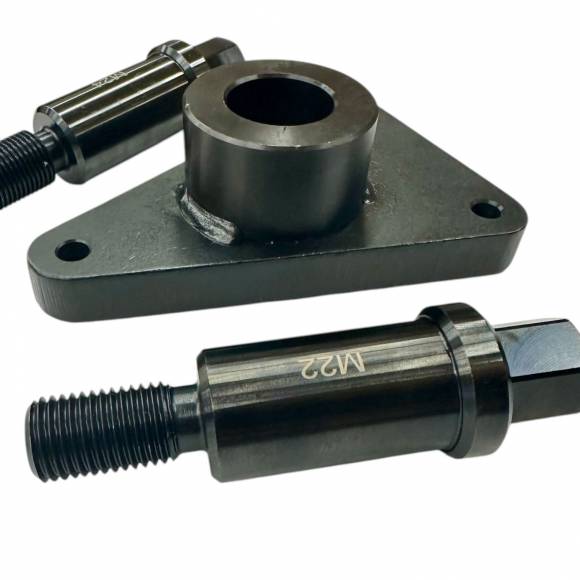
A cocked cam gear at install is the single fastest way to scrap a fresh rebuild. The ATC J-35906-A Cam Gear Pilot exists for one reason — to put that risk to zero on every Series 60 timing job that crosses your bay.
The Problem: Cam Gear Misalignment Is a Silent Engine Killer
When you bolt a cam gear onto a Detroit Diesel Series 60 camshaft without a proper pilot, you are guessing. The gear hub may look square against the cam — until you torque it down and discover it sat 0.005" cocked the whole time. Gear teeth that meshed perfectly on the bench now ride uneven against the crank gear. Within hours of run-in, you start hearing the whine. Within thousands of miles, you have premature gear wear, timing drift, and a comeback the customer is going to be unhappy about. The fix isn't more torque or more sealant — it's a precision pilot tool that physically prevents the gear from sitting wrong.
- Squares the Gear to the Cam: The pilot centers and supports the cam gear hub during install so it cannot cock or shift while the bolt is drawn down.
- Old AND New Bolt Style Compatible: Works on every Series 60 production variant — early-style bolt and updated-style bolt, single tool covers your entire shop's Series 60 mix.
- Protects the Cam Mounting Surface: Eliminates the side-load that scuffs and burrs the camshaft hub face during install — surface damage that cannot be undone in the bay.
- Ensures Clean Tooth Engagement: Proper pilot positioning means the cam gear teeth mesh evenly with the idler from the first revolution — no break-in damage, no whine.
- Built to Last: Heavy-duty 9-lb construction holds dimensional spec across thousands of installation cycles in pro fleet, OE, and independent diesel shops.
$140 of Insurance Against a $20,000 Rebuild Comeback
Run the math. A Detroit Diesel Series 60 in-frame rebuild runs $12,000–$18,000 in parts and labor on the conservative end. An out-of-frame is well north of $20,000. The cam gear is one component on that bill — but if it's installed wrong, every other component on the work order is at risk. A misaligned cam gear can chew up the idler gear it meshes with, drift timing out of spec, and put the entire fresh assembly into early failure. The ATC J-35906-A Cam Gear Pilot is $140. That is the whole insurance premium against a fresh rebuild that comes back under warranty for a timing-related failure. There is no diesel shop in North America where that math doesn't make sense.
Failure Modes: What Happens When Cam Gear Alignment Goes Wrong
Series 60 engines have been in service since 1987. After three decades of field experience, the failure modes from improper cam gear installation are well-documented. Every one of them traces back to the same root cause: the gear was not perfectly square to the camshaft when the bolt was torqued.
1. Premature gear tooth wear. A cam gear that sits even half a degree out of square against its mating idler gear creates uneven contact pressure across the tooth face. One side of every tooth carries the load; the other side runs unloaded. Within a few thousand miles you get visible step wear on the loaded faces. Within a service interval you have audible gear noise. Within an oil change cycle past that, you have metallic debris in the pan and an oil sample that flags hard wear metals.
2. Timing drift. A cocked cam gear changes the effective angular relationship between the cam and the crank. It's a small displacement — but on a precision-injection diesel engine, small timing displacement means measurable changes in fuel delivery timing, exhaust opening events, and combustion phasing. The result: rough idle, reduced power, worse fuel economy, and sometimes intermittent codes that a tech can chase for hours without a clean diagnosis. The fix is pulling the front cover and re-installing the gear correctly.
3. Camshaft mounting surface damage. When a gear cocks during install, the contact line between the gear hub and the cam hub face concentrates load onto a tiny area. Burrs and scuffs on that mating surface are common. Once the surface is damaged, you cannot get a clean fit even with the pilot tool installed correctly — the gear sits on the high spots and cocks again. Now you're either dressing the cam hub face with a stone (bay-floor improvisation) or replacing the camshaft (the right answer, expensive answer).
4. Bolt fatigue and breakage. A misaligned gear places bending stress on the cam gear retaining bolt. Series 60 cam gear bolts are not designed for bending load — they're designed for clean axial clamping force. A bolt that takes bending stress for a few hundred operating hours can fatigue and snap. A snapped cam gear bolt mid-engine is a catastrophic event you do not want explained to you by the customer.
Every one of these failure modes is fully prevented by using the J-35906-A pilot during install. There is no skilled-tech workaround. The pilot is the prevention.
Real-World Shop Scenarios
Scenario A — The Fleet Rebuild Program. A regional carrier runs 80 tractors with Series 60 power. Annual cam-related events across the fleet are in the 10–15 range counting scheduled rebuilds and unscheduled timing work. The fleet shop standardized on the J-35906-A pilot three years ago. Cam gear-related comebacks dropped to zero. The shop manager calculates the tool paid for itself on the first prevented warranty event and has been pure margin protection ever since.
Scenario B — The Mixed-Era Rebuild Shop. An independent diesel shop services Series 60 engines from across the production run — early models with the old-style cam gear bolt, mid-life and later units with the updated bolt design. Without the J-35906-A's dual-bolt-style compatibility, the shop would need separate tooling for each variant. With one pilot tool covering both, the shop's inventory and per-job tooling time both drop. Same tool, every Series 60 cam gear install, no exceptions.
Scenario C — The Low-Hour Marine Rebuild. A marine diesel shop is rebuilding a Series 60 from a workboat application. Hours are low but the engine has sat for years and the rebuild is going by the book. The tech installs the cam gear with the J-35906-A pilot, torques to spec, and verifies timing reference. Engine fires on the first crank, idles smooth, runs to load test without a single timing-related issue. The customer takes delivery on schedule. That is what professional cam gear installation looks like.
Where the J-35906-A Belongs in Your Series 60 Workflow
This pilot belongs in your special-tools cabinet right alongside your Series 60 timing pin set, your barring tool, and your injector hold-down tools. It comes off the wall any time the cam gear is removed for service — and that includes any in-frame or out-of-frame rebuild, any cam replacement, any timing-event diagnosis where the gear has to come off and go back on, and any front-end repair that touches the cam-to-idler gear stack.
For shops doing more than two or three Series 60 jobs a year, the J-35906-A is not optional. It is the same category of tool as your torque wrench: the work cannot be done correctly without it. The 9-lb construction tells you everything about how it's built — this is not a hobby tool. It is a permanent special-tools investment that performs the same job, at the same precision, year after year, install after install.
Pair the pilot with the OE Detroit Diesel service manual torque sequence, fresh assembly oil on threads (not anti-seize, which falsifies torque readings on Series 60 cam gear bolts), and a calibrated wrench, and you have the complete kit needed to install a Series 60 cam gear correctly the first time, every time.
Fleet ROI: The Pilot Tool That Pays for Itself on Day One
Take a 25-truck Series 60 fleet doing one major engine rebuild per year on average — pretty typical for an aging Series 60 fleet still in service. That's 25 cam gear installations per year across the fleet rotation. Industry data on improperly-installed cam gear comeback rates ranges from 3% to 8% depending on tech experience and tooling. Take the conservative 3% — that's roughly one warranty event per year on a fleet this size where cam gear alignment was the root cause.
One warranty event on a fresh Series 60 rebuild — pulling the front cover, replacing damaged components, redoing labor — runs $4,500–$7,000 conservatively. The J-35906-A pilot tool costs $140. The first prevented comeback covers the tool roughly 35 times over. Every subsequent prevented comeback is direct margin protection.
For independent shops the math is even more compelling. A small shop doing 6–10 Series 60 rebuilds per year cannot afford a single warranty comeback — the labor cost alone wipes out the margin on multiple successful jobs. The J-35906-A is the cheapest possible insurance against the most expensive possible outcome. Buy once. Use forever. Sleep at night.
$140 today. Career-long protection on every Series 60 cam gear install your shop will ever do. This is the math that gets the tool ordered before lunch.
Frequently Asked Questions
Q1: Does this really work on both old-style and new-style cam gear bolts?
Yes. The J-35906-A is engineered to pilot the cam gear hub itself, so it works regardless of which retaining bolt configuration the engine uses. One tool covers your entire Series 60 service mix from early production through late production.
Q2: Is the J-35906-A an OEM-equivalent pilot?
The tool is built to OEM service-procedure specifications and matches the J-35906-A reference called out in Detroit Diesel Series 60 service literature. It is suitable for use in dealer, fleet, and independent diesel shop environments.
Q3: Can I install a Series 60 cam gear without this tool?
Technically yes — you can put a cam gear on with a hammer and hope. But if you want to install one that does not come back as a warranty event in the next 12 months, the answer is no. The pilot is the difference between a job that holds and a job that drifts.
Q4: Will this work on Detroit Diesel DD13/DD15 or older 8V/12V engines?
No. The J-35906-A is platform-specific to the Detroit Diesel Series 60. The DD13/DD15 platforms have entirely different cam gear architecture, and the legacy two-stroke 8V/12V engines use unrelated timing geometry. For multi-platform shops, plan on platform-specific pilots for each engine family.
Q5: How heavy is this tool, and does it ship from stock?
The J-35906-A ships at 9 lbs from stock at apexinds.com. Free continental US shipping applies on orders over $500. Standard ground transit times apply.
Q6: Does it come with instructions?
The tool's operation is intuitive for any technician familiar with Series 60 cam gear installation procedures. For the formal installation sequence and torque values, reference the current Detroit Diesel Series 60 service manual — the J-35906-A slots into the procedure exactly where the manual calls for cam gear pilot alignment.
Q7: Is this tool a one-time use or does it last?
The J-35906-A is a permanent special-tool. It has no consumable wear components and is built for repeated professional use. Most shops use a single pilot for the life of the shop's Series 60 service capability.
Q8: Why is this tool $140 when I can find cheaper "Series 60 cam tools" online?
Because the J-35906-A actually does the alignment job correctly. Generic or knockoff cam gear tools may look similar but lack the precision dimensional control that makes a pilot tool actually work as designed. On a $20,000 rebuild, $40 saved on a knockoff tool is the worst possible economy. Buy the right tool once.
Stop Gambling on Series 60 Cam Gear Installs.
Get the precision pilot the Series 60 service procedure was built around — in stock, ships fast, $140.00.
SHOP THE ATC J-35906-A — $140.00📞 812-579-5478 / 800-365-2233 | Mon–Fri 8 a.m.–5 p.m. ET
Free shipping on US orders over $500
overall rating:
my rating:
log in to rate